
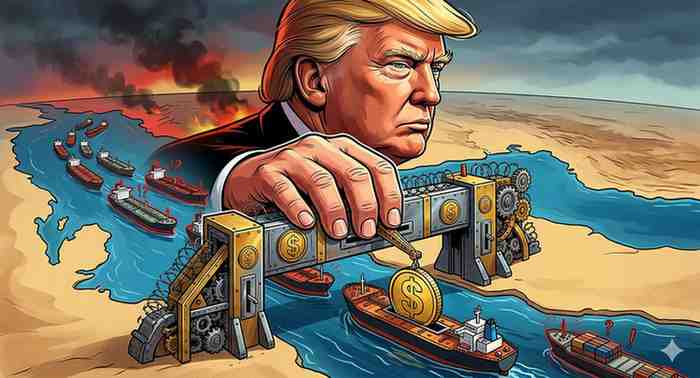
Washington D.C., April 2026 — In a move that could fundamentally reshape global energy trade, U.S. President Donald Trump has floated a controversial proposal to charge ships a toll for passage through the Strait of Hormuz. Following the recent U.S.-Iran hostilities, Trump argued that as the “winner” of the conflict, the United States should oversee
Washington D.C., April 2026 — In a move that could fundamentally reshape global energy trade, U.S. President Donald Trump has floated a controversial proposal to charge ships a toll for passage through the Strait of Hormuz. Following the recent U.S.-Iran hostilities, Trump argued that as the “winner” of the conflict, the United States should oversee the waterway’s administration, asserting, “If Iran can charge ships, why shouldn’t the United States?”
The World’s Busiest Oil Highway
The Strait of Hormuz is the most critical maritime chokepoint on the planet, handling nearly 20% of the world’s oil and liquefied natural gas (LNG) supply. If Hormuz chokes, the global economy gasps.
Trump’s proposal suggests a shift toward direct U.S. military control to enforce this “guarded toll road.” Geography makes the strait a natural bottleneck—a narrow 33 km passage where few viable alternative routes exist, making it the ultimate leverage point for global energy influence.
A Legal and Economic Minefield
The plan faces immediate hurdles under international law. Under the United Nations Convention on the Law of the Sea (UNCLOS), the strait is meant to remain open to all ships without discrimination. Any attempt to impose a “pay-to-pass” system could trigger a cascade of legal and diplomatic battles.
The economic impact is already being felt. Even the threat of disruption has pushed oil prices above $100 per barrel. Experts warn that these costs do not stay at sea; they travel straight to consumers in the form of higher gas prices and inflated shipping costs for everyday goods.
The Burden on Global Consumers
For major energy importers like India, the stakes are exceptionally high. India imports nearly 90% of its crude oil, much of which transits through Hormuz. A U.S.-imposed toll would:
- Directly increase freight costs and India’s national oil import bill.
- Force governments to either absorb the shock or pass the burden to citizens.
- Disrupt established trade routes that have operated under “free passage” norms for decades.
Power Over Profit
Reports suggest Iran has already moved to capitalize on the post-war chaos, allegedly charging up to $2 million per ship for limited passage while seeking global recognition of its authority. For the U.S., the move isn’t just about revenue—it’s about asserting total influence over global energy flow. Trump has signaled that if allies want a secure route, they may eventually have to secure it themselves or pay for the protection provided by the U.S. Navy.
Bottom Line
The era of “free seas” in the Middle East is under threat. Whether managed by Iran or the United States, the turning of a global energy artery into a commercial toll road suggests that the cost of energy security is about to become a direct tax on the world’s economy. The masks of “diplomatic protection” are falling, revealing a new reality: those who control the chokepoint control the world’s wallet.











Leave a Comment
Your email address will not be published. Required fields are marked with *