
New Delhi, April 2026 — Arvind Kejriwal, the chief of the Aam Aadmi Party (AAP), has dramatically altered the course of his legal battles by declaring a “political Satyagraha” against the judiciary. In a move that mirrors his early days of high-stakes activism, the former Delhi Chief Minister has refused to continue his defense before
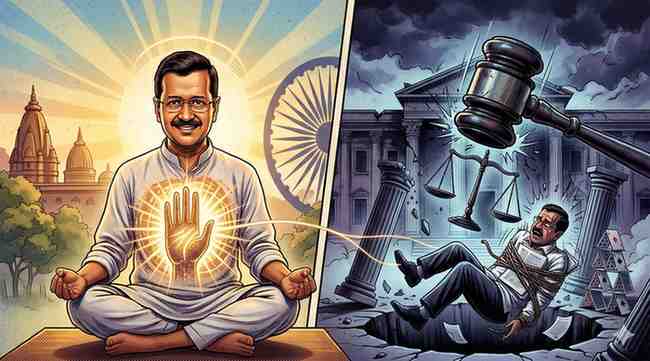
New Delhi, April 2026 — Arvind Kejriwal, the chief of the Aam Aadmi Party (AAP), has dramatically altered the course of his legal battles by declaring a “political Satyagraha” against the judiciary. In a move that mirrors his early days of high-stakes activism, the former Delhi Chief Minister has refused to continue his defense before Justice Swarana Kanta Sharma, setting the stage for a constitutional showdown.
Comparing Self to Tilak: A Risky Narrative
In a letter addressed to the court, Kejriwal drew a bold parallel between his current situation and that of freedom fighter Lokmanya Bal Gangadhar Tilak. He claimed he would no longer present his case before the current bench, effectively positioning himself as a victim of a biased system rather than a defendant in a corruption probe.
Critics and legal analysts argue that comparing a democratic legal process to colonial-era resistance is a stretch. While Tilak fought an oppressive foreign regime, Kejriwal is navigating a structured judicial system with multiple layers of appeal—options he is currently choosing to ignore.
The Recusal Demand: Strategy or Desperation?
The friction peaked when Kejriwal’s legal team filed a recusal application, demanding Justice Sharma withdraw from the case. The grounds? Allegations regarding her family’s past legal work and her attendance at events linked to the RSS.
When the court rejected these claims as insufficient to prove bias, Kejriwal pivoted to non-cooperation. By doing so, he has moved the battle from the courtroom to the court of public opinion, a classic move in his “victim card” political playbook.
The “Ex-Parte” Trap: A Legal Self-Goal?
By refusing to participate, Kejriwal is taking a massive legal gamble. Under Indian law, the court does not stop for a non-cooperative defendant. Instead, it can initiate ex-parte proceedings, meaning the judge will hear only the side of the CBI and ED.
Without a defense to counter the prosecution’s claims, the court could deliver a decisive ruling based solely on the government’s evidence. This could lead to a long-term legal crisis that no amount of political messaging can easily undo.
History of the “Satyagrahi” Defense
This isn’t Kejriwal’s first attempt at judicial defiance. In 2014, he refused to pay bond in a defamation case filed by Nitin Gadkari, opting for jail instead. However, that “Satyagraha” ended with a written apology and a bail bond four years later.
The current stakes are significantly higher. Dealing with money laundering charges under the PMLA, the “arrest first, explain later” nature of the law means that non-cooperation rarely results in political leverage; instead, it often leads to prolonged incarceration.
Bottom Line: Masterstroke or End of the Road?
Kejriwal’s refusal to engage with the bench is a high-wire act. While it may consolidate his base by framing him as a crusader against a “fixed” system, it leaves him defenseless against serious criminal charges. In the battle between political narrative and the rule of law, the structures of the judiciary usually have the final word. Kejriwal is betting his political future that this time, the rules will be different.










Leave a Comment
Your email address will not be published. Required fields are marked with *