
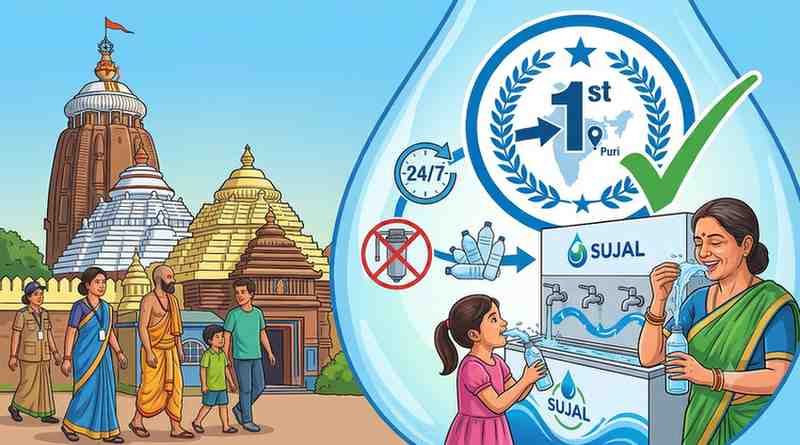
Puri, June 2026 — In a historic shift for Indian municipal infrastructure, the holy city of Puri has officially become the nation’s first to provide its residents and visitors with 24/7 access to high-quality drinking water directly from the tap. What was once considered an impossible urban feat is now a reality, setting a new
Puri, June 2026 — In a historic shift for Indian municipal infrastructure, the holy city of Puri has officially become the nation’s first to provide its residents and visitors with 24/7 access to high-quality drinking water directly from the tap. What was once considered an impossible urban feat is now a reality, setting a new benchmark for public utility management.
From Ground Disparity to Surface Success
For decades, Puri’s water security was fragile. The city relied heavily on groundwater, but rapid tourism growth—bringing nearly 100,000 floating visitors daily to a city of 300,000—put immense pressure on local aquifers. Environmental degradation, including seawater intrusion and contamination from nearby dumping sites, left many residents with saline, unsafe borewell water.
To solve this, the city successfully transitioned its primary supply to surface water from the Bhargavi River, a distributary of the Mahanadi river system. This move was not just a change in source, but a fundamental overhaul of how water reaches the consumer.
The “Source to Tap” Engineering
The transformation is built on a robust, multi-stage treatment process. Raw water is moved through a system of clarifiers, chemical treaters, and advanced ultra-filtration units. The water is then stored in reservoirs and distributed through a looped, sectoral pipeline network that allows for precise, zone-by-zone pressure control.
This infrastructure is designed to deliver water that is safe to drink directly—no boiling or home filtration required. To maintain this standard, the city employs continuous online monitoring and independent third-party lab testing, even deploying mobile testing labs during major events like the Rath Yatra to ensure safety remains consistent during peak crowds.
The Human Element: The “Jal Sathis”
Puri’s model isn’t just about pipes and pumps; it’s about community trust. The city introduced the concept of “Jal Sathis”—a force primarily composed of local women. These frontline workers handle utility fee collections and serve as a direct reporting line for any maintenance issues. By integrating local community members into the operational loop, the city has bridged the gap between municipal administration and the residents they serve.
The Reality Check
While Puri stands as an inspiring model, the transition is not without its growing pains. Some residents have reported inconsistencies in water supply timings, leading to frustration for those who previously relied on their own storage systems. Furthermore, while the municipal supply is treated, experts emphasize that the long-term success of this initiative depends on the health of the broader Mahanadi basin. Pollution levels in connecting water bodies remain a reminder that urban water safety is tied to environmental protection.
The Bottom Line
Puri’s journey proves that with systematic planning, high-quality infrastructure, and community collaboration, the “drink from tap” dream is achievable in India. As other cities continue to grapple with the complex challenges of urban water supply, Puri offers a clear message: clean, accessible water is not just a luxury, but an essential service that can be secured through political will and modern engineering.









Leave a Comment
Your email address will not be published. Required fields are marked with *