
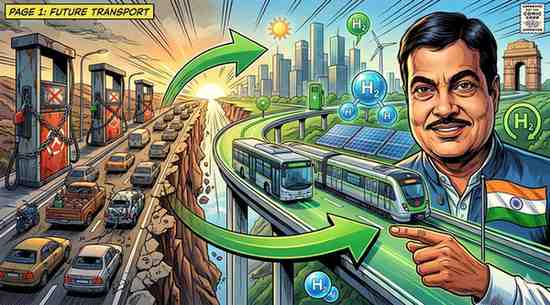
New Delhi, April 2026 — Union Minister for Road Transport and Highways Nitin Gadkari has issued a definitive ultimatum to India’s automotive giants: adapt to green energy or face obsolescence. In a high-stakes address, Gadkari signaled that the golden age of petrol and diesel is over, pivoting the nation’s focus toward a high-tech, public-transport-first economy.
New Delhi, April 2026 — Union Minister for Road Transport and Highways Nitin Gadkari has issued a definitive ultimatum to India’s automotive giants: adapt to green energy or face obsolescence. In a high-stakes address, Gadkari signaled that the golden age of petrol and diesel is over, pivoting the nation’s focus toward a high-tech, public-transport-first economy.
The Death of Diesel and Petrol
In what many are calling his most candid warning to date, Gadkari told industry leaders there is “no future” for fossil-fuel-driven vehicles. Citing an annual import bill of ₹22 lakh crore for fossil fuels, the Minister framed the transition as both an economic necessity and a moral imperative to combat suffocating urban pollution.
“If you are in the mood to expand [petrol and diesel]… your future is not good,” Gadkari warned, urging manufacturers to divert every rupee of research and development into electric mobility and biofuels.
Public Transport: The New Benchmark
After a decade spent blanketing the country in world-class highways, Gadkari’s “Next Big Focus” is the quality of the vehicles moving on them. He slammed the current state of Indian public transport, noting that domestic buses often fail to meet international standards.
The government’s new mandate is 101% perfection in design and quality. The vision is to replace aging, polluting fleets with “clean, indigenous, and cost-effective” alternatives, moving away from private vehicle dependency toward a robust, world-class public transit network.
The $55 Breakthrough
The Minister highlighted a dramatic shift in EV economics. The cost of lithium-ion batteries—once the biggest barrier to adoption—has plummeted from $150 to just $55 per kilowatt-hour. Gadkari predicted that within the next six months, the cost of an electric vehicle will reach parity with petrol and diesel models, removing the “price tag” excuse for consumers.
With 6% of the world’s lithium recently discovered in Jammu and Kashmir, India is also positioning itself to stop importing battery components and start manufacturing them domestically.
From “Annadata” to “Urjadata”
In a radical reimagining of the Indian economy, Gadkari described a future where farmers are no longer just food providers (Annadata) but energy providers (Urjadata).
- Ethanol Revolution: Vehicles like the Toyota Innova are already running on 100% bio-ethanol produced from rice straw, bamboo, and sugar cane.
- The Cost Factor: These ethanol-run cars effectively reduce fuel costs to ₹25 per liter, compared to the soaring prices of petrol.
- Green Hydrogen: Calling it the “fuel of the future,” Gadkari confirmed pilot projects for hydrogen-powered trucks and buses are already active on Indian roads.
Bottom Line: The “Mirai” Vision
Gadkari frequently references the Toyota Mirai—which translates to “Future”—as his personal pilot project. The message to the industry is clear: the government is no longer asking for change; it is demanding it. For an industry that contributes massive GST revenue and employs over 4.5 crore people, the stakes couldn’t be higher. India is no longer content being an energy importer; it intends to export the fuels of the next century.








Leave a Comment
Your email address will not be published. Required fields are marked with *