
Berlin, May 2026 — The Biden-Trump era of military cooperation has reached a breaking point. In a move that signals a “Germany First” pivot in American withdrawal strategy, the Pentagon has confirmed the removal of 5,000 U.S. troops, fundamentally altering the security architecture of Europe. While the administration frames this as a strategic realignment, critics
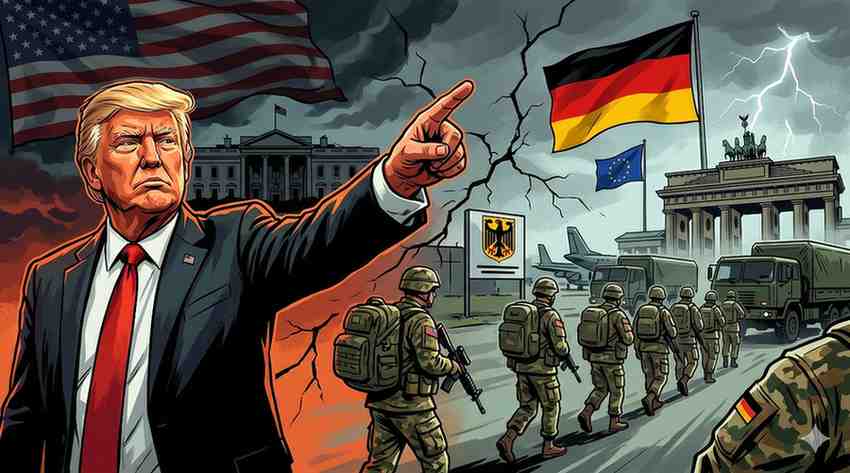
Berlin, May 2026 — The Biden-Trump era of military cooperation has reached a breaking point. In a move that signals a “Germany First” pivot in American withdrawal strategy, the Pentagon has confirmed the removal of 5,000 U.S. troops, fundamentally altering the security architecture of Europe.
While the administration frames this as a strategic realignment, critics and European allies see it as a calculated act of “geopolitical ghosting” designed to punish Germany for its lack of support in the ongoing conflict with Iran.
The Punishment Strategy: Troops for Tariffs
The withdrawal isn’t happening in a vacuum. President Trump’s decision comes directly on the heels of a public fallout with German Chancellor Friedrich Merz, who criticized the U.S. strategy in the Iran war as “humiliating.
The White House is hitting Berlin where it hurts most:
- Military: Pulling 17% of the 36,000 troops currently stationed in Germany.
- Economic: Implementing a 25% tariff on European-produced cars and trucks, a move that threatens to cripple the German automotive industry.
A Messaging Crisis in the Pentagon
Militarily, the loss of 5,000 soldiers—roughly one brigade combat team—is manageable. However, the symbolic “deterrence gap” it creates is massive.
Internal chaos at the Pentagon has further fueled the fire. Reports indicate that the various branches of the U.S. military had no prior knowledge of the order, learning about the withdrawal in real-time alongside the press. Furthermore, the cancellation of the long-range fires battalion deployment has raised red flags for Republican leaders, who fear the U.S. is signaling a “green light” to Vladimir Putin as the war in Ukraine enters its fifth year.
Germany’s Strategic Hub Under Pressure
Germany isn’t just another host; it is the “beating heart” of American operations overseas. It hosts:
- Command Centers: Headquarters for both U.S. European and Africa Commands.
- Logistics: Ramstein Air Base, the most critical U.S. hub in the world.
- Nuclear Assets: Crucial U.S. nuclear missiles and the Landstuhl Medical Center.
By pulling troops from these critical zones, the U.S. is essentially testing how much weight Germany can carry on its own.
The “5% Reality”: Europe’s New Defense Era
German Defense Minister Boris Pistorius has responded with a measured, almost weary tone. He acknowledged that the era of relying on the American security umbrella is fading, urging European nations to accelerate their own military infrastructure.
NATO allies are now scrambling to meet a staggering 5% GDP investment goal for defense—a massive jump from the previous 2% target.
Bottom Line
The withdrawal of 5,000 troops is more than a headcount change; it’s a divorce settlement. For years, the U.S. provided security while Germany provided the platform. Now, that deal is being torn up in favor of trade wars and tactical retreats. Europe is no longer just a partner; it is a competitor being told to fund its own protection.












Leave a Comment
Your email address will not be published. Required fields are marked with *