
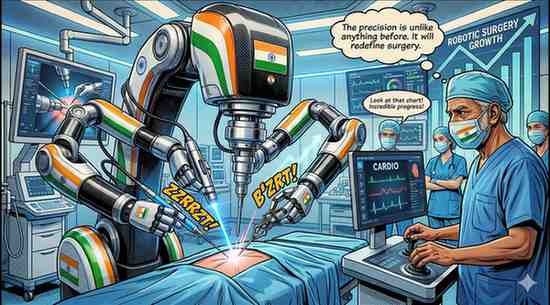
NEW DELHI — In a quiet revolution within the nation’s hospitals, the scalpel is increasingly being held not by a human hand, but by high-precision robotic arms. As India pushes toward self-reliance in healthcare, the SSI Mantra—the country’s first homegrown robotic surgery system—is shattering the long-held belief that advanced medical technology must be an imported
NEW DELHI — In a quiet revolution within the nation’s hospitals, the scalpel is increasingly being held not by a human hand, but by high-precision robotic arms. As India pushes toward self-reliance in healthcare, the SSI Mantra—the country’s first homegrown robotic surgery system—is shattering the long-held belief that advanced medical technology must be an imported luxury.
Redefining the Surgeon’s Seat
The heart of this transformation lies in the surgeon’s command center. Far from the traditional “hands-on” approach, surgeons now sit at a specialized console, immersed in a high-definition 3D view of the patient’s internal anatomy. By manipulating sensitive hand and foot controls, they direct robotic arms that enter the body through tiny, “keyhole” incisions.
This isn’t just a remote-controlled camera; it’s an enhancement of human capability. The robotic “wrists” offer a range of motion that exceeds human flexibility, allowing for complex maneuvers in tight spaces—from head and neck surgeries down to the pelvis.
Decentralizing Care: From Metros to Small Towns
For years, robotic surgery was a “Tier 1” privilege, limited by the massive ₹15–18 crore price tag of international systems like the Da Vinci. The SSI Mantra has disrupted this economic barrier. Priced at approximately ₹6 crore, it has made advanced surgery financially viable for smaller, regional hospitals.
The impact is already visible: nearly 70% of these systems are now installed in Tier 2 and Tier 3 cities. This shift ensures that a patient in a small town can access the same level of surgical precision as one in a major metro, without the immense burden of travel or exorbitant private costs.
Telesurgery: The Ultimate “Work from Home”
The most futuristic application of this technology is its ability to bridge vast distances through “telesurgery.” In landmark cases, Indian surgeons have performed operations on patients hundreds—and even thousands—of kilometers away.
Whether it is a surgeon in a living room in Delhi operating on a patient in Jaipur, or a specialist in France treating a patient in Indore, the geographical barrier to expert care is effectively collapsing. As long as high-speed connectivity is available, the “best doctor” is no longer out of reach.
Closing the Trust Gap
Despite the “robotic” label, experts are quick to clarify that the machine is a “slave robot”—it only moves when the surgeon does, featuring safety sensors that freeze movement if the surgeon looks away.
As clinical data shows faster recovery times and fewer complications, patient skepticism is rapidly turning into demand. Surgeons report that patients now specifically request the robotic approach, recognizing the benefits of smaller scars, less pain, and a quicker return to their daily lives.
Bottom Line
While the era of “fantasy gaming” faced a moral reckoning, the medical world is seeing a moral victory in “Make in India.” By democratizing access to robotics, India is ensuring that the future of surgery isn’t just about innovation—it’s about inclusivity. The masks are off: the robot is the tool, but the goal is making world-class healing affordable for every citizen.











Leave a Comment
Your email address will not be published. Required fields are marked with *