
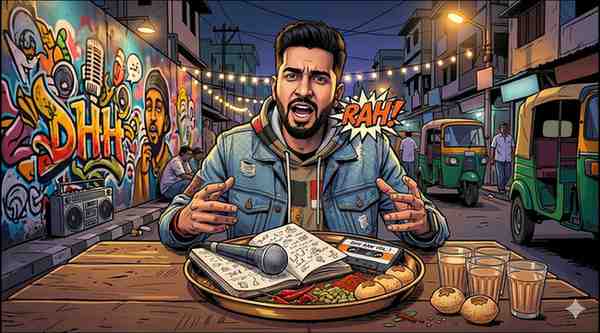
Mumbai, April 2026 — In a brutally honest sit-down on “Brut Plate,” Garv Taneja, known professionally as Chaar Diwaari, has pulled back the curtain on the Indian music industry. The bedroom producer turned internet sensation used the platform to critique the current state of Desi Hip-Hop (DHH) and the soul-crushing rise of artificial intelligence. The
Mumbai, April 2026 — In a brutally honest sit-down on “Brut Plate,” Garv Taneja, known professionally as Chaar Diwaari, has pulled back the curtain on the Indian music industry. The bedroom producer turned internet sensation used the platform to critique the current state of Desi Hip-Hop (DHH) and the soul-crushing rise of artificial intelligence.
The 90% Mediocrity Rule
Chaar Diwaari didn’t mince words regarding the current wave of Desi Hip-Hop. Despite his own success and collaborations with industry heavyweights, he maintains that “90% of DHH music coming out right now is mediocre.”
His critique targets a lack of emotional resonance. He described much of the genre’s output as “word salad”—technically proficient “lyrical miracle” rap that ultimately “makes me feel nothing.” According to Taneja, the scene has become obsessed with an “alpha-masculine” posturing that serves as a mask for insecurity rather than a vehicle for authentic expression.
The Myth of the “Genius” Process
While fans often view his chaotic, high-energy tracks as meticulously planned, Taneja revealed his process is rooted in a total lack of direction. Unlike producers who use rigid templates for drums and bass to speed up the workflow, he insists on starting every project with a “blank slate.”
“The trick is to not think,” he explained. “The more you think, the more it becomes a ‘product.’ The less you think, the more it’s fun.” This “flow state” philosophy is how tracks like Iss Tarah evolved—starting as a chorus written years ago in music school and ending as a collaboration with legend Sonu Nigam, simply because Taneja realized he didn’t have the vocal range to hit the notes himself.
AI: The Death of the Artist’s Journey
As generative AI begins to flood the music market, Chaar Diwaari took a firm stand against the technology. His issue isn’t with the quality of the output, but the erasure of the struggle.
“AI kills the process, and the process is the point of art,” he stated. He categorized those who prioritize the final product over the creation as “businessmen” or “tech bros” rather than artists. For Taneja, art is found in the mistakes and the unexpected places a human creator ends up—something a data-driven remix cannot replicate.
The Internet as a “Third Parent”
Addressing his “cult” status, Taneja credited his eclectic sound to being a child of the web since age 12, calling the internet his “third parent.” While other artists warn against over-consuming content to “protect authenticity,” Diwaari advocates for the opposite: consuming as much art, film, and culture as possible.
His success proves that an artist can be “internet-made” without being “trend-driven.” By refusing to follow “three-second hook” rules or template reels, he has built a brand on being “borderline autistic” in his content—unfiltered, strange, and entirely his own.
Bottom Line
Chaar Diwaari’s interview serves as a wake-up call for an industry obsessed with virality and efficiency. His message is clear: if you are creating out of fear of being irrelevant, you’ve already lost. True art requires “getting your hands dirty” and operating out of love for the game, not the paycheck.











Leave a Comment
Your email address will not be published. Required fields are marked with *