
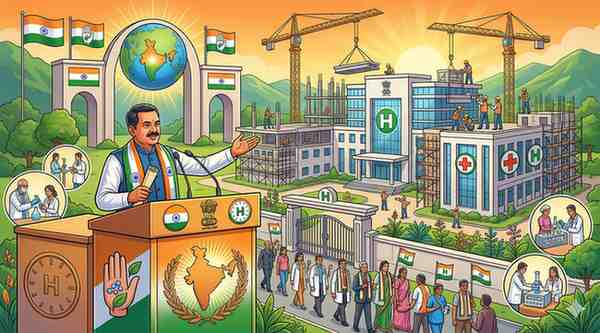
India is accelerating its push to integrate homeopathy into mainstream healthcare, with the AYUSH Ministry announcing expanded training programmes and new research initiatives on World Homoeopathy Day 2026. The government aims to position India as a global leader in alternative medicine while addressing chronic disease management in underserved rural areas. New Delhi, April 2026 —
India is accelerating its push to integrate homeopathy into mainstream healthcare, with the AYUSH Ministry announcing expanded training programmes and new research initiatives on World Homoeopathy Day 2026. The government aims to position India as a global leader in alternative medicine while addressing chronic disease management in underserved rural areas.
New Delhi, April 2026 — The Union Ministry of AYUSH commemorated World Homoeopathy Day on April 10, unveiling a series of policy measures designed to strengthen homeopathic education, research infrastructure, and primary healthcare delivery across India’s vast rural network.
Why Is India Investing Heavily in Homeopathy?
India houses the world’s largest homeopathic infrastructure, with over 200,000 registered practitioners and 195 colleges offering degree programmes. The government views alternative medicine systems as cost-effective solutions for managing chronic ailments in areas where allopathic specialists remain scarce. Under the National AYUSH Mission, district-level homeopathic hospitals have expanded from 235 in 2020 to over 380 in 2026, primarily serving Tier-2 and Tier-3 cities.
What New Initiatives Were Announced?
The AYUSH Ministry confirmed the establishment of five new regional research centres under the Central Council for Research in Homoeopathy. These centres will focus on evidence-based clinical trials for lifestyle diseases including diabetes, hypertension, and respiratory disorders. Additionally, a digital telemedicine platform exclusively for AYUSH consultations will receive Rs 120 crore in funding this fiscal year.
- India has 195 homeopathy colleges producing approximately 13,000 graduates annually
- World Homoeopathy Day marks the birth anniversary of Dr Samuel Hahnemann, founder of homeopathy
- The AYUSH sector’s market size is projected to reach Rs 1.5 lakh crore by 2028
- Over 100 million Indians reportedly use homeopathic treatments as primary or complementary care
- New research centres will conduct clinical trials meeting WHO-standard protocols
What Do Critics and Supporters Say?
Medical associations remain divided on expanding alternative medicine coverage under public health schemes. Proponents argue that integrative approaches reduce pharmaceutical dependency and healthcare costs. Sceptics, including the Indian Medical Association, continue demanding rigorous scientific validation before further mainstreaming. The AYUSH Ministry has responded by mandating peer-reviewed research protocols for all new treatment claims.
What Happens Next?
Parliament is expected to consider amendments to the Homoeopathy Central Council Act later this year, potentially introducing stricter accreditation standards for colleges and practitioners. The government’s push aligns with its broader vision of positioning traditional medicine as an export-ready sector, targeting markets in Europe and Southeast Asia where demand for alternative therapies is growing steadily.











Leave a Comment
Your email address will not be published. Required fields are marked with *