
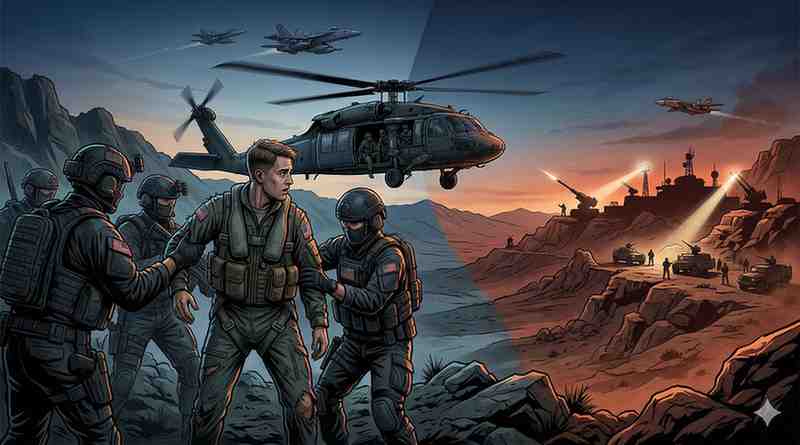
A US Air Force serviceman was successfully extracted from Iranian territory after his aircraft went down during a surveillance mission near the Persian Gulf, marking the first such incident since the 1980 Operation Eagle Claw disaster. The rescue operation has triggered a diplomatic crisis between Washington and Tehran, with ripple effects reaching India’s energy security
A US Air Force serviceman was successfully extracted from Iranian territory after his aircraft went down during a surveillance mission near the Persian Gulf, marking the first such incident since the 1980 Operation Eagle Claw disaster. The rescue operation has triggered a diplomatic crisis between Washington and Tehran, with ripple effects reaching India’s energy security and strategic calculations in West Asia.
New Delhi, April 2026 — The dramatic rescue of an American airman from behind enemy lines in Iran has pushed US-Iran relations to their most volatile point in years, forcing India to recalibrate its delicate diplomatic balance between its strategic partnership with Washington and its long-standing ties with Tehran.
What Happened During the Rescue Operation?
According to US Central Command, the airman ejected safely after his reconnaissance aircraft experienced mechanical failure over Iranian airspace on April 5. Special operations forces executed a covert extraction within 18 hours, retrieving the serviceman from a remote region near the Iraq-Iran border. Tehran has condemned the operation as a violation of its sovereignty and threatened retaliatory measures. Washington maintains the aircraft was conducting routine operations in international airspace when the incident occurred.
Why Does This Matter for India?
India imports approximately 10 percent of its crude oil from Iran through special rupee-payment arrangements negotiated around Western sanctions. Any military escalation in the Persian Gulf could disrupt these energy supplies and spike global oil prices, directly impacting India’s import bill. New Delhi has historically maintained working relationships with both nations, but this incident tests that diplomatic tightrope. The Ministry of External Affairs has called for restraint from all parties while monitoring developments closely.
- India’s Chabahar Port project with Iran could face renewed scrutiny from Washington
- Gulf shipping lanes handle 40 percent of India’s total oil imports
- Over 8 million Indian expatriates live in Gulf Cooperation Council countries
- Indian Navy has increased surveillance patrols in the Arabian Sea
- Rupee-rial trade mechanism shields some transactions from dollar-based sanctions
How Are Global Powers Responding?
The United Nations Security Council held an emergency session on April 6, though no resolution emerged due to expected vetoes. Russia and China have backed Iran’s demand for an international investigation into the airspace violation. European Union foreign policy chief issued a statement urging de-escalation and offered mediation services. Israel has placed its military forces on heightened alert, citing concerns about Iranian proxy retaliation.
What Happens Next?
Diplomatic channels remain open, with Swiss intermediaries facilitating back-channel communications between Washington and Tehran. India’s petroleum ministry has activated contingency plans for alternative oil sourcing from Saudi Arabia and Iraq if supplies are disrupted. Defence analysts expect increased American naval presence in the Strait of Hormuz, potentially complicating India’s independent maritime operations in the region. The next 72 hours will prove critical in determining whether this incident becomes a footnote or a flashpoint.












Leave a Comment
Your email address will not be published. Required fields are marked with *