
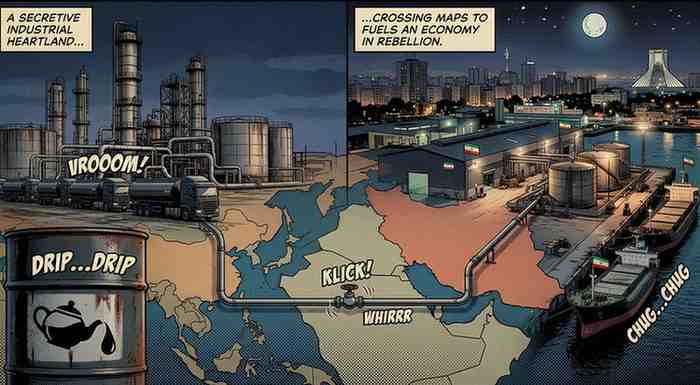
BEIJING, March 2026 — As the military standoff between Israel, the U.S., and Iran intensifies, a quiet economic operation is keeping Tehran from the brink of collapse. While Western sanctions aim to choke the Iranian state, China has emerged as a high-stakes financial lifeline, moving billions in oil revenue through an invisible, “shadow” infrastructure. The
BEIJING, March 2026 — As the military standoff between Israel, the U.S., and Iran intensifies, a quiet economic operation is keeping Tehran from the brink of collapse. While Western sanctions aim to choke the Iranian state, China has emerged as a high-stakes financial lifeline, moving billions in oil revenue through an invisible, “shadow” infrastructure.
The “Teapot” Strategy: Bypassing Global Giants
The trade does not happen through state-owned energy giants, which are vulnerable to U.S. sanctions. Instead, Beijing utilizes “teapots”—small, independent refineries that operate largely outside the traditional global financial system.
For these refineries, Iranian crude is a goldmine: it is often purchased at a steep discount, sometimes several dollars below global market prices. For Beijing, it is cheap energy; for Tehran, it is “survival cash” that keeps the state functioning despite total international isolation.
A Ghost Fleet in the Dark
The physical movement of this oil relies on a sophisticated “shadow fleet” of aging tankers. To remain invisible to regulators, these vessels employ a variety of deceptive tactics:
- Identity Swapping: Tankers frequently change names and registration flags mid-voyage.
- Going Dark: Crews disable AIS tracking systems to vanish from global monitors.
- Mid-Sea Transfers: Oil is moved from one ship to another in international waters to mask its true origin.
On paper, this oil often appears to come from other nations—or simply doesn’t exist at all. In reality, it is the fuel powering the world’s second-largest economy.
The Yuan vs. The Dollar
The financial plumbing of this relationship is designed to be “sanction-proof.” Transactions are increasingly settled in Chinese Yuan rather than U.S. Dollars, routed through a complex maze of front companies and offshore accounts. By avoiding the dollar-denominated banking system, China and Iran have created a closed-loop economy that Western authorities find nearly impossible to intercept.
Beyond Oil: Diplomatic Armor
China’s support isn’t just financial; it’s structural. By brokering the 2023 rapprochement between Iran and Saudi Arabia and backing Iran’s entry into the BRICS and the Shanghai Cooperation Organization, Beijing has given Tehran a global platform.
This calibrated support allows China to back its ally without triggering a direct military confrontation with the West. For Beijing, Iran offers strategic geography and influence in West Asia—a region critical to global trade routes.
Bottom Line
While the world watches missiles fly, the real war for survival is being fought in the hulls of tankers and the ledgers of offshore banks. Without China, Iran’s oil has nowhere to go. In this high-stakes game of geopolitical chess, survival isn’t just about firepower—it’s about who keeps the money flowing when the rest of the world tries to shut it down.










Leave a Comment
Your email address will not be published. Required fields are marked with *