
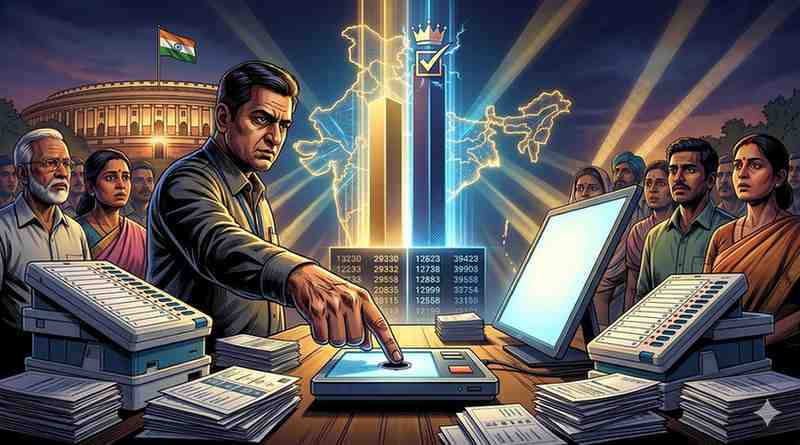
New Delhi, May 2026 — As the final phase of polling concludes, India transitions from the heat of political rallies to the clinical precision of the counting room. While the public sees rapidly shifting numbers on television screens, the reality of “Counting Day” is a meticulously choreographed, multi-layered operation designed to protect the sanctity of
New Delhi, May 2026 — As the final phase of polling concludes, India transitions from the heat of political rallies to the clinical precision of the counting room. While the public sees rapidly shifting numbers on television screens, the reality of “Counting Day” is a meticulously choreographed, multi-layered operation designed to protect the sanctity of the world’s largest democratic exercise.
The Strong Room: Where Democracy Pauses
The journey of a vote from a booth to the final tally begins in the Strong Room. These high-security enclosures house Electronic Voting Machines (EVMs) under 24/7 surveillance by central paramilitary forces and CCTV. On counting morning, typically between 7:00 AM and 8:00 AM, these rooms are unsealed only in the presence of candidates, their authorized agents, and independent observers appointed by the Election Commission of India (ECI).
The Sequence: Postal Ballots First
The first pulse of data comes at 8:00 AM with the counting of postal ballots. These represent a diverse slice of the electorate: armed forces personnel, government officials on election duty, and “absentee voters,” including senior citizens and voters with disabilities. While EVMs provide the bulk of the volume, postal ballots are counted manually and often act as an early barometer for high-stakes, neck-and-neck contests.
Round-by-Round: The EVM Marathon
Once the postal tally is underway, the EVM counting begins. The process is organized into rounds to maintain order and transparency. In each round, a batch of roughly 14 EVMs (representing 14 polling stations) is brought to the counting tables.
- Verification: Agents from every political party stand behind a wire mesh, squinting at the machine display to verify that the seal is intact and the unique ID matches their records.
- The Tally: The “Result” button is pressed, and the machine reveals the candidate-wise breakup. These figures are recorded, signed by the agents, and then uploaded to the ECI’s central portal.
The Audit: VVPAT Cross-Verification
In an era of digital skepticism, the Voter Verifiable Paper Audit Trail (VVPAT) serves as the ultimate manual override. To ensure the machines haven’t been tampered with, the ECI mandates a physical count of VVPAT paper slips from five randomly selected polling stations in every constituency. If there is even a single-vote discrepancy between the EVM and the paper slip, the paper count prevails.
The Final Verdict
Despite the “breaking news” flashes on media channels, a candidate is not officially declared a winner until the Returning Officer (RO) completes every round and cross-verifies the totals. Only after the final verification is the “Certificate of Election” handed over — a simple piece of paper that marks the transition of a citizen into a legislator.
Bottom Line
Counting Day is not merely an administrative task; it is an audit of the nation’s trust. Behind the flashing graphics of newsrooms lies a rigorous manual and electronic system where every seal, every signature, and every paper slip ensures that the person who takes the oath of office was truly the person the people chose.











Leave a Comment
Your email address will not be published. Required fields are marked with *