
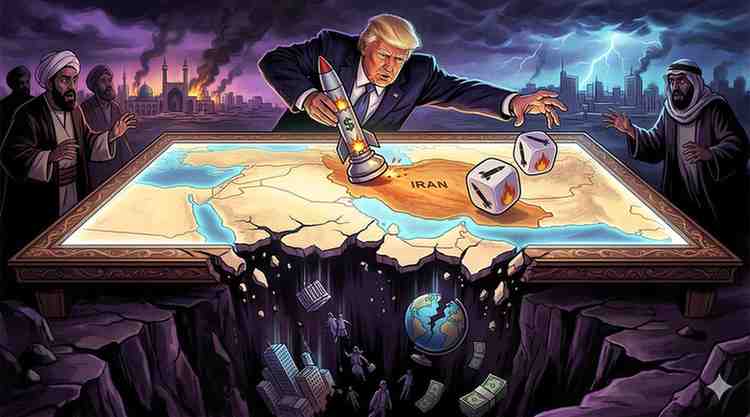
NEW DELHI, March 13, 2026 — As the conflict between the United States, Israel, and Iran enters its second week, the global economy is grappling with a reality that many leaders—including U.S. President Donald Trump—appear to have underestimated. What was initially framed as a targeted military operation has rapidly evolved into a systemic threat to
NEW DELHI, March 13, 2026 — As the conflict between the United States, Israel, and Iran enters its second week, the global economy is grappling with a reality that many leaders—including U.S. President Donald Trump—appear to have underestimated. What was initially framed as a targeted military operation has rapidly evolved into a systemic threat to global trade, with the “hidden” leverage of the Middle East now coming to the forefront.
The Economic Miscalculation
The early days of the conflict were marked by a sense of surrealism, as the Trump administration seemed to downplay the potential for long-term economic fallout. However, the closure of the Strait of Hormuz has shattered that narrative. Beyond the immediate 20% hit to global oil supplies, the blockade has exposed a critical vulnerability in the high-tech sector: the supply of Helium and Bromine.
With Qatar producing roughly 40% of the world’s helium—a non-negotiable component for semiconductor cooling and lithography—the effective shutdown of regional trade routes is sending shockwaves through the global chip industry. Analysts warn that a prolonged blockade could take up to 25% of the world’s helium off the market, threatening to derail the global AI boom.
The “Affordability” Crisis Hits Home
For the average consumer, the geopolitical struggle is manifesting as a direct hit to the pocketbook. In the United States, gasoline prices have surged past $5 per gallon in some states, while in India, the price of a domestic LPG cylinder has risen by ₹60 overnight.
The political stakes are equally high. With the U.S. midterm elections approaching in November, the White House is facing a mounting “affordability” crisis. President Trump is now under immense pressure to stabilize energy markets—potentially through emergency oil reserve releases—to prevent the war from becoming a fatal political liability.
A War of Attrition and Reparations
Adding to the uncertainty is the rhetoric from Iran’s new leadership. Following the transition to Mojtaba Khamenei, Tehran has shifted from defensive posturing to a demand for full war reparations. The Iranian military has explicitly warned the West to “get ready for $200 a barrel oil,” tying regional security directly to the global price of fuel.
Iran’s strategy is clear: if the enemy refuses to pay for material losses incurred during the conflict, Tehran will continue to use its “strategic tool of pressure”—the Strait of Hormuz—to inflict equivalent financial damage on the global stage.
Bottom Line
The conflict has moved far beyond a localized military skirmish. It is now a battle of economic endurance. Whether through the skyrocketing cost of gasoline, the potential collapse of semiconductor manufacturing, or the staggering $10 billion daily cost to the U.S. taxpayer, the “hidden” costs of this war are only just beginning to be realized. As the Strait remains closed, the world is learning that in modern warfare, the most effective weapon isn’t always a missile—it’s the supply chain.









Leave a Comment
Your email address will not be published. Required fields are marked with *