
New Delhi, April 2026 — A fresh legislative push to expand India’s Lok Sabha from 543 to nearly 850 members has ignited a fierce constitutional debate. While the government frames the move as a necessary step to address population growth since 1971, the opposition warns that the bill could structurally marginalize southern states and weaken
New Delhi, April 2026 — A fresh legislative push to expand India’s Lok Sabha from 543 to nearly 850 members has ignited a fierce constitutional debate. While the government frames the move as a necessary step to address population growth since 1971, the opposition warns that the bill could structurally marginalize southern states and weaken the checks and balances of Indian democracy.
The Southern State Disadvantage
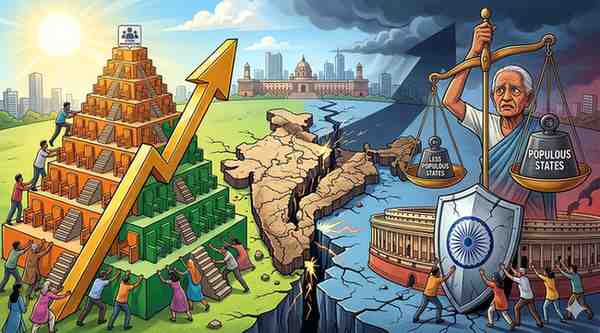
The central concern for critics is the ambiguity regarding which census data will be used to redraw constituencies. The bill references a “later census” without specific dates, leading to fears that using more recent figures will penalize states like Kerala and Tamil Nadu.
Because southern states have successfully implemented population control measures over the last 50 years, a purely population-based seat allocation would see their political weight decrease relative to northern states. While the government maintains that seats will not decrease but rather “proportionately increase,” critics point out that this guarantee is not codified in the actual text of the bill.
Executive Control and “Gerrymandering”
The proposed law significantly alters how and when delimitation—the process of redrawing electoral boundaries—takes place. Currently, the Constitution mandates delimitation after every census to ensure transparency.
The new bill, however, grants the government the power to decide the timing and the specific census to be used. Furthermore, it removes the requirement for a two-thirds majority to pass these changes. This shift has prompted accusations from the opposition that the government could engage in “gerrymandering”—the practice of redrawing district lines to create an unfair electoral advantage for the ruling party.
Marginalizing the Rajya Sabha
One of the most profound impacts of the bill is the potential erosion of the Rajya Sabha’s influence. India’s bicameral system was designed as a check on the Lok Sabha; however, expanding the lower house to 850 members would drastically shift the power balance during joint sessions.
The strength of the Lok Sabha compared to the Rajya Sabha would jump from 2.2 times to 3.3 times. In the event of a disagreement between the two houses, a government with a strong Lok Sabha majority would find it significantly easier to bypass the “House of Elders” entirely, potentially silencing the diverse regional interests the Rajya Sabha represents.
Silencing Small Voices
The logistical reality of adding 300 more MPs also raises concerns about the quality of parliamentary debate. With more members competing for the same limited amount of time during sessions like “Zero Hour,” the opportunity for individual MPs—especially those from smaller regional parties—to ask questions and hold ministers accountable will diminish.
While the new Parliament building is physically equipped to house 850 members, activists argue that a crowded floor does not necessarily equate to a more effective democracy.
Bottom Line
The Delimitation Bill is being marketed as a mathematical necessity for fair representation, but for the opposition, it represents a fundamental rewrite of the Indian political map. As the debate moves toward a vote, the fight isn’t just about the number of seats—it’s about whether the “House of the People” will still have room for the voices of every state.











Leave a Comment
Your email address will not be published. Required fields are marked with *