
New Delhi, May 2026 — The Union Government has officially moved to dismantle the “dual-connection” culture in Indian kitchens. Under the newly enforced “One Household, One Gas Connection” mandate, households with a functional Piped Natural Gas (PNG) connection are now prohibited from holding subsidized Liquefied Petroleum Gas (LPG) cylinders. What the Ministry of Petroleum calls
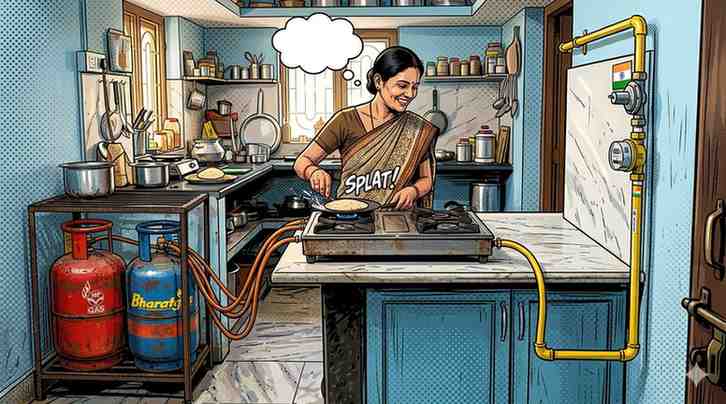
New Delhi, May 2026 — The Union Government has officially moved to dismantle the “dual-connection” culture in Indian kitchens. Under the newly enforced “One Household, One Gas Connection” mandate, households with a functional Piped Natural Gas (PNG) connection are now prohibited from holding subsidized Liquefied Petroleum Gas (LPG) cylinders.
What the Ministry of Petroleum calls a “strategic rationalization,” critics argue is a move that strips urban consumers of their energy safety net.
The Death of the “Double Benefit”
For years, millions of urban middle-class families maintained both a PNG line for daily cooking and a subsidized LPG cylinder as a “backup.” The government’s logic is now firm: if a house has a permanent pipe, it doesn’t need a subsidized bottle.
Oil Marketing Companies (OMCs) have been directed to identify these “double-dip” households. The goal is to plug massive subsidy leakages where government-funded discounts were being hoarded by those with modern infrastructure, rather than reaching those in need.
Cracking Down on the Black Market
Beyond household convenience, the policy targets a deeper rot: the diversion of domestic gas. Subsidized cylinders intended for homes frequently end up in commercial kitchens, hotels, and roadside dhabas.
By mandating a single connection verified via Aadhaar-linked digital tracking, the government aims to stop the illegal flow of cheap domestic gas into the commercial sector. This shift ensures that every subsidized rupee is accounted for, moving away from a universal subsidy model to a strictly “targeted” one.
Geopolitics and the Energy Squeeze
The timing is no coincidence. With rising tensions in West Asia and disruptions in maritime routes like the Strait of Hormuz, the cost of importing LPG has skyrocketed. India remains one of the world’s largest importers of LPG, and the government is desperate to reduce this dependency.
By pushing urban India toward PNG—which is easier to monitor and integrate into city infrastructure—the government hope to reserve LPG stocks for rural areas and remote villages where pipelines are physically impossible to lay.
The Backup Crisis: Choice vs. Control
The policy has met with resistance from residents in Tier-1 cities like Delhi, Mumbai, and Pune. Consumer groups argue that PNG infrastructure is not infallible; maintenance issues or pipe damage can leave a kitchen cold for hours.
“The LPG cylinder was our insurance policy,” says one resident. Critics warn that by removing this choice, the government is making the urban middle class vulnerable to single-point failures while simultaneously phasing out their subsidies.
Bottom Line
The “One Household, One Gas Connection” rule is more than an administrative tweak; it is a total overhaul of India’s welfare architecture. The era of “backup cylinders” is ending, replaced by a digital, metered, and strictly monitored energy grid. While it promises efficiency and energy security, for many, it marks the end of a long-standing domestic flexibility.









Leave a Comment
Your email address will not be published. Required fields are marked with *