
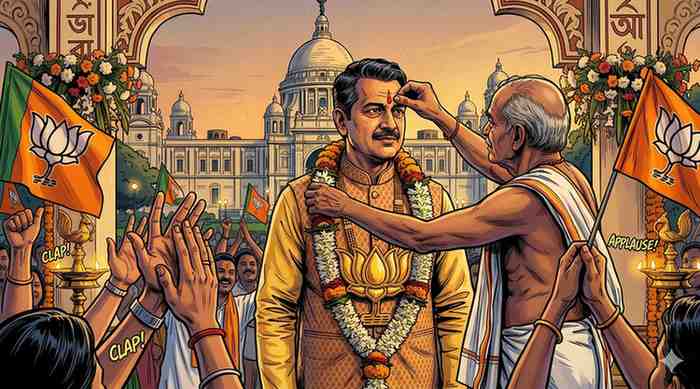
KOLKATA, May 2026 — In a monumental political earthquake, the Bharatiya Janata Party (BJP) has swept the West Bengal assembly elections, securing a massive 208 out of 294 seats. This dramatic victory has ended the 15-year uniterrupted rule of Mamata Banerjee’s Trinamool Congress (TMC), and marks the collapse of nearly half a century of non-BJP
KOLKATA, May 2026 — In a monumental political earthquake, the Bharatiya Janata Party (BJP) has swept the West Bengal assembly elections, securing a massive 208 out of 294 seats. This dramatic victory has ended the 15-year uniterrupted rule of Mamata Banerjee’s Trinamool Congress (TMC), and marks the collapse of nearly half a century of non-BJP ideological dominance in the state.
Following high-level consultations between Home Minister Amit Shah and newly elected MLAs, the party high command has selected Suvendu Adhikari as West Bengal’s next Chief Minister.
The Fall of a Titan
The transition of power was preceded by deep political drama. While outgoing Chief Minister Mamata Banerjee initially refused to tender her resignation and alleged electoral malpractice, the state Governor dissolved the outgoing assembly, paving the way for the new government [00:34].
The choice of Suvendu Adhikari is highly strategic. Adhikari achieved the ultimate “giant-killer” narrative by defeating Mamata Banerjee in Nandigram in 2021, and repeating this feat by defeating her in Bhabanipur in the 2026 elections [04:09]. His ability to directly take down the state’s most formidable leader made him the undisputed choice to lead the BJP government.
The Ultimate Insider Turned Rival
Adhikari’s deep understanding of the TMC’s internal machinery made him an invaluable asset. Once considered Mamata Banerjee’s right-hand man and a core architect of the 2007 Nandigram movement that brought the TMC to power, Adhikari jumped ship to the BJP in 2020 [04:56]. His grassroots connection and intimate knowledge of TMC’s rural expansion strategies provided the BJP with the exact regional face it lacked.
This strategic choice heavily mirrors the “Himanta Model” successfully utilized by the BJP in Assam, where a powerful, localized former rival (Himanta Biswa Sarma) was elevated to lead the state, successfully shaking off the “outsider” label the opposition often placed on the BJP [06:22].
A New Political Equation
Adhikari fundamentally transformed the BJP’s appeal in Bengal. By merging regional Bengali identity with Hindutva politics, he consolidated the votes of Hindu refugees, the Matua community, urban middle-class voters frustrated by political violence and unemployment, and tribal groups in the western Jangalmahal region [08:05].
The Challenges Ahead
Despite the massive mandate, Adhikari’s road ahead is treacherous. Upon his selection, Adhikari promised to replace fear with trust (Bhay Out, Bharosa In), addressing the severe political violence that plagued the election cycle, which tragically claimed the life of his own personal assistant [11:10].
The new Chief Minister will also face stiff bureaucratic resistance from an administration molded by 50 years of Left and TMC rule [11:37]. Furthermore, he inherits a state heavily burdened by massive debt, industrial stagnation, unemployment, and the complex task of managing relations with the state’s 27% Muslim minority demographic without alienating his core voter base.
Bottom Line
The BJP’s triumph in Bengal secures their final eastern frontier, significantly expanding their geopolitical and parliamentary influence. Suvendu Adhikari, with his unmatched mass mobilization skills and deep regional roots, has successfully engineered the unthinkable. Now, he faces the monumental task of governing a deeply fractured state.











Leave a Comment
Your email address will not be published. Required fields are marked with *