





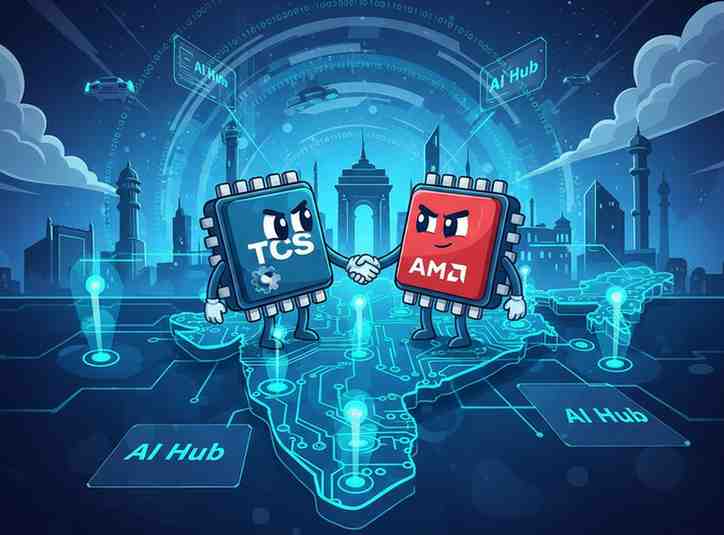
Mumbai, February 2026-In a move that signals India’s transition from an IT service hub to a global AI infrastructure powerhouse, Tata Consultancy Services (TCS) and semiconductor giant AMD have unveiled a massive partnership. By deploying the state-of-the-art Helios rack-scale architecture, the duo aims to build one of the world’s most formidable AI-ready data center capacities
Mumbai, February 2026-In a move that signals India’s transition from an IT service hub to a global AI infrastructure powerhouse, Tata Consultancy Services (TCS) and semiconductor giant AMD have unveiled a massive partnership. By deploying the state-of-the-art Helios rack-scale architecture, the duo aims to build one of the world’s most formidable AI-ready data center capacities right on Indian soil.
The 200-Megawatt Blueprint
At the core of this announcement is a blueprint for data centers capable of supporting up to 200 megawatts of power. This isn’t just a marginal upgrade; it is a gargantuan leap in compute capacity designed to host tens of thousands of high-performance AI servers simultaneously.
The infrastructure utilizes AMD’s high-octane Instinct Mi455X GPUs and next-generation EPYC Venice CPUs, creating a hardware stack specifically tuned for the grueling demands of Large Language Model (LLM) training and generative AI.
Hyperval: The Billion-Dollar Engine
The execution of this vision falls to Hyperval, a specialized subsidiary launched by TCS in 2025. Focused exclusively on “gigawatt-scale” AI infrastructure, Hyperval is fueled by a $1 billion investment from TPG.
Both TCS and its partners have committed a staggering ₹18,000 crore over the coming years. This capital injection is a response to India’s explosive data center needs; the nation’s capacity is projected to surge from 1.5 GW today to over 10 GW by 2030.
Sovereign AI: Independence from the West
Perhaps the most strategic aspect of the TCS-AMD deal is the push for “Sovereign AI.” By building localized, open-source-based infrastructure, India can develop, train, and deploy AI models domestically.
This reduces the country’s reliance on foreign clouds and ensures that sensitive data stays within national borders. It also places AMD in a head-to-head battle with Nvidia for dominance in an Indian AI market expected to hit $210 billion by the end of the decade.
A Competitive Edge for Enterprises
For Indian businesses, this partnership translates to:
- Reduced Latency: Faster AI processing for domestic users.
- Cost Efficiency: Lower operational costs compared to renting international server space.
- Scalability: The ability for startups to scale from “pilot projects” to massive “global deployments” overnight.
Bottom Line
The TCS-AMD collaboration isn’t just a corporate deal; it’s a foundational brick for India’s digital future. As global titans like Microsoft and Amazon pour billions into the region, this domestic-led initiative ensures that India isn’t just a consumer of the AI revolution, but the factory where it is built.



















Leave a Comment
Your email address will not be published. Required fields are marked with *