
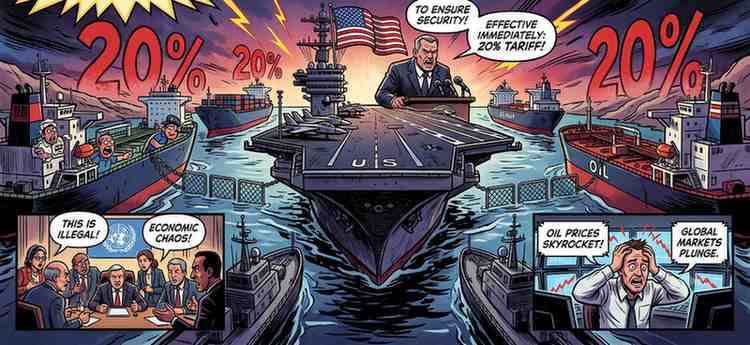
Washington, July 2026 — Donald Trump has sent shockwaves through the global economy by declaring that the United States will now act as the “guardian” of the Strait of Hormuz, enforcing a staggering 20% toll on all commercial cargo passing through the vital waterway. What the administration frames as a necessary reimbursement for maritime security,
Washington, July 2026 — Donald Trump has sent shockwaves through the global economy by declaring that the United States will now act as the “guardian” of the Strait of Hormuz, enforcing a staggering 20% toll on all commercial cargo passing through the vital waterway.
What the administration frames as a necessary reimbursement for maritime security, critics call a reckless escalation that turns a critical international choke point into an unprecedented global toll zone.
The Sudden Flare-Up Over a Global Choke Point Until early 2026, the Strait of Hormuz operated normally, serving as a peaceful lifeline for major energy-importing nations like India. However, a severe, direct conflict between the US and Iran shattered that status quo.
While a subsequent 60-day Memorandum of Understanding (MoU) briefly raised hopes of a permanent diplomatic deal, Trump abruptly tore up the agreement. Sensing an opportunity, a newly confident Iran moved to claim operational control over the strait, prompting Trump’s dramatic, business-style counter-move to monetize the route’s security.
A Business Approach to International Waters Trump’s justification applies corporate logic to global geopolitics: American taxpayers should no longer foot the bill alone for protecting international commerce. The administration argues that its expensive naval deployments—including aircraft carriers, destroyers, and submarines—are the only barrier preventing an outright Iranian shutdown of the channel.
Under the new directive, the US Navy will continue operations to keep the passage open, but passing cargo ships must pay a hefty 20% fee based on their total cargo value.
The Legal and Economic Backlash The policy faces immense international resistance and will be fiercely contested by global governments and legal experts. Under the United Nations Convention on the Law of the Sea (UNCLOS), the Strait of Hormuz is designated as an international transit passage, granting all nations free navigation rights without fee obligations. Because the US holds zero territorial sovereignty over these waters, critics argue the collection mechanism is completely illegal.
The economic fallout hit immediately. Following the announcement, global crude oil prices instantly surged past $80 per barrel. If strictly enforced, a 20% surcharge on crude oil will severely inflate shipping costs, triggering widespread global inflation across transportation, food, and manufacturing sectors.
Iran’s Strategic Exploitation In an ironic twist, Trump’s announcement has handed Iran the perfect excuse to advance its own revenue goals. Long looking for leverage to control the waterway, Tehran quickly responded by calling the US fee extortionate while introducing its own “fair value” alternative toll of 4% to 5%, capitalising on the breakdown of international norms.
Bottom Line The era of free transit through the Strait of Hormuz is under direct threat. By treating a critical geopolitical artery like a private toll road, the US has created an economic shockwave that could force major importing nations to completely alter their energy supply chains, leaving consumers worldwide to pay the ultimate price.









Leave a Comment
Your email address will not be published. Required fields are marked with *