
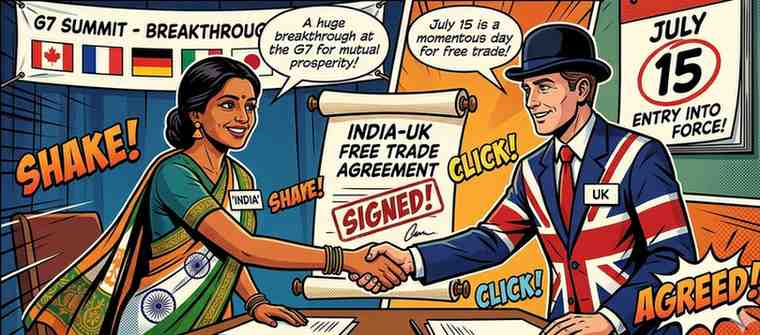
NEW DELHI / LONDON — After months of intense negotiation and friction over steel tariffs, India and the United Kingdom have finalized a breakthrough deal to bring their landmark Free Trade Agreement (FTA) into force on July 15. What supporters hail as a monumental economic partnership, however, is a high-stakes bet to reshape trade between
NEW DELHI / LONDON — After months of intense negotiation and friction over steel tariffs, India and the United Kingdom have finalized a breakthrough deal to bring their landmark Free Trade Agreement (FTA) into force on July 15.
What supporters hail as a monumental economic partnership, however, is a high-stakes bet to reshape trade between the world’s fifth and sixth largest economies in an era of global uncertainty.
The Bilateral Breakthrough at G7
The final timeline was locked in following a critical sideline meeting between Indian Prime Minister Narendra Modi and British Prime Minister Keir Starmer at the G7 summit in France.
While the diplomatic machinery had stalled over market protections, both leaders pushed the relationship into an aggressive new phase centered on raw trade. British government projections estimate the deal could eventually inject £4.8 billion into the UK economy and expand long-term bilateral trade by over €2 billion.
Whiskeys and Wheels: India Lowers the Shield
For years, India has heavily guarded its domestic markets with steep import duties. Under the new agreement, those protective walls are coming down:
- British Whiskey: India’s massive 150% tariff on Scotch and British spirits will plumet to 40% over the next decade.
- Automobiles: Tariffs on British vehicles will be systematically slashed to 10% under a newly established quota system.
Clothing and Compromise: The Steel Standoff
In return, Indian manufacturers gain a powerful foothold in one of Europe’s largest consumer hubs. The UK will eliminate or sharply cut tariffs on core Indian exports, including clothing, footwear, and food products.
The deal nearly collapsed, however, over Britain’s strict new steel safeguard measures taking effect July 1, designed to block cheap global imports. To prevent a trade war, a last-minute compromise was carved out: Indian officials confirmed that roughly 85% of India’s steel exports will be exempt from the new restrictions, while the remaining volume will be handled through specialized quotas to avoid market disruption.
Shifting the Corporate Labor Burden
Beyond industrial cargo, the pact introduces a major cost-cutting relief for multinational companies. The two nations have expanded provisions to eliminate “double contributions” to social security. Under the revised rules, temporary overseas employees sent on assignment will be exempt from paying into both countries’ social security systems simultaneously for up to five years—an extension from the previous three-year cap.
Bottom Line
Nearly a year after the paperwork was first signed, the India-UK FTA is turning into a live economic reality. As global supply chains fracture, New Delhi and London are opening their borders to each other—gambling that deeper integration will deliver the growth, jobs, and industrial resilience that both nations desperately need.












Leave a Comment
Your email address will not be published. Required fields are marked with *