
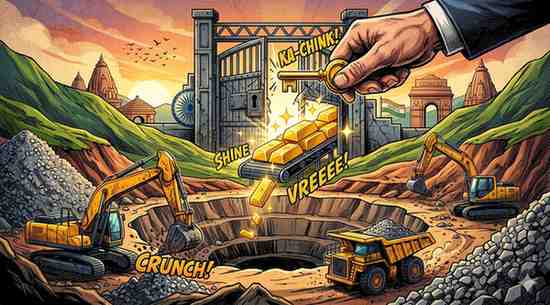
Andhra Pradesh, April 2026 — India is set to revive its status as the “Golden Bird” as it prepares to operationalize its first large-scale private gold mine since independence. The Jonnagiri Gold Project, located in the Kurnool district of Andhra Pradesh, marks a historic departure from decades of sluggish state-run mining and promises to challenge
Andhra Pradesh, April 2026 — India is set to revive its status as the “Golden Bird” as it prepares to operationalize its first large-scale private gold mine since independence. The Jonnagiri Gold Project, located in the Kurnool district of Andhra Pradesh, marks a historic departure from decades of sluggish state-run mining and promises to challenge India’s staggering reliance on foreign gold imports.
The End of a State Monopoly
For over 75 years, gold mining in India was the exclusive playground of the public sector—a period defined by the rise and eventual collapse of the iconic Kolar Gold Fields (KGF). When KGF shut down in 2001 due to mounting costs and outdated technology, India’s domestic production effectively flatlined, leaving the nation 99% dependent on imports.
The Jonnagiri project, developed by Geomysore Services and backed by Deccan Gold Mines, represents the first major success of the government’s recent mining reforms. By amending the Mines and Minerals Development and Regulation (MMDR) Act to allow private auctions, the government has finally traded the inefficiency of “License Raj” for private sector capital and precision.
A Geological Treasure in the Dharwar Craton
The mine is strategically situated on the Dharwar Craton, a mineral-rich belt that shares the same geological DNA as the legendary Kolar fields.
- Proven Reserves: 13 tons of gold are ready for immediate extraction.
- Potential Upside: Exploration suggests the site could hold upwards of 40 tons.
- The Method: Unlike river-bed panning, this is “Hard Rock” mining. It involves crushing quartz veins and sulfide ores, followed by advanced “Carbon-in-Leach” processing to recover the precious metal.
India’s ₹5 Lakh Crore Habit
India consumes between 700 to 800 tons of gold annually, trailing only behind China. This hunger isn’t just about jewelry; it’s a deep-seated cultural obsession driven by weddings, festivals like Dhanteras, and a traditional distrust of banking systems in rural areas.
This obsession comes at a massive macroeconomic cost. Gold is India’s second-largest import after crude oil. By spending billions in US dollars to satisfy domestic demand, India consistently faces a widened Trade Deficit and a depreciating Rupee. Jonnagiri is the first serious attempt to plug this “capital drain” with homegrown resources.
Short-Term Milestone vs. Long-Term Reality
While the buzz is high, experts warn that one mine won’t stop the import ships overnight.
- Immediate Impact: The mine will produce roughly 1 ton per year—a fraction of the 800 tons needed.
- The Multiplier Effect: The real value lies in the “Investment Multiplier.” If Jonnagiri proves profitable, it will trigger a wave of foreign and domestic investment into other dormant gold belts.
- Growth Targets: Analysts believe that with enough private participation, India could eventually scale domestic production to 100 tons annually, significantly cushioning the economy.
The Challenges Ahead
The path to gold is paved with hurdles. Private players must navigate:
- Environmental Scrutiny: The use of cyanide in ore processing requires airtight waste management to prevent toxic leaks.
- Social Displacement: Land acquisition in tribal and rural belts remains a sensitive flashpoint for large-scale projects.
- Market Volatility: Unlike government entities, private mines are vulnerable to global gold price fluctuations which can turn a profitable vein into a financial liability overnight.
Bottom Line
The Jonnagiri Gold Project is more than just a mining venture; it is a policy breakthrough. It proves that India’s soil still holds immense wealth—if the government is willing to step aside and let technology and private enterprise lead the way. For a nation that has spent billions buying gold from the world, it’s finally time to start digging for its own.









Leave a Comment
Your email address will not be published. Required fields are marked with *