
DOHA, March 20, 2026 — The global energy landscape has been permanently altered following a devastating missile attack on Qatar’s Ras Laffan Industrial City. What began as a regional skirmish has escalated into a structural crisis, wiping out 17% of the nation’s Liquefied Natural Gas (LNG) capacity and threatening to plunge international markets into a
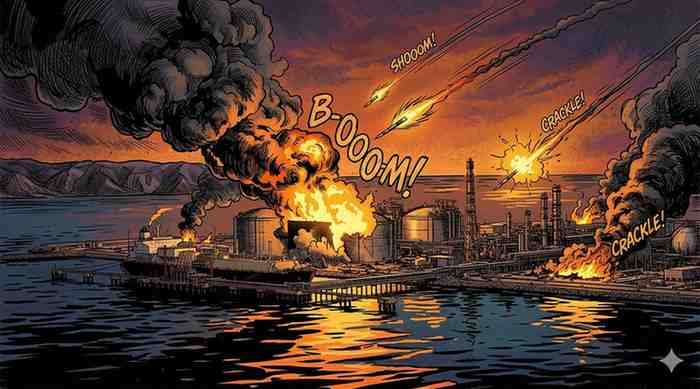
DOHA, March 20, 2026 — The global energy landscape has been permanently altered following a devastating missile attack on Qatar’s Ras Laffan Industrial City. What began as a regional skirmish has escalated into a structural crisis, wiping out 17% of the nation’s Liquefied Natural Gas (LNG) capacity and threatening to plunge international markets into a multi-year supply vacuum.
Retaliation Reaches the World’s Gas Tank
The strike on March 18 was not an isolated incident but a direct response to Israel’s earlier bombardment of Iran’s South Pars gas field. As the dust settles at Ras Laffan—which handles nearly 20% of the global LNG trade—the scale of the destruction is becoming clear.
According to QatarEnergy CEO Saad Al-Kaabi, two of the country’s 14 essential LNG “trains” and a major gas-to-liquids facility have been sidelined. Experts estimate the damage to these $26 billion facilities will take three to five years to repair, removing 12.8 million tons of LNG from the market annually.
The “Force Majeure” Ripple Effect
The impact extends far beyond the borders of the Gulf. QatarEnergy has officially declared force majeure on long-term contracts, leaving major economies in a lurch:
- Europe: Countries like Italy and Belgium, which pivoted to LNG to escape reliance on Russian pipelines, now face a dire energy winter.
- Asia: Heavyweights China and South Korea, which rely on Qatari gas for industrial power, are seeing their primary supply lines severed.
- By-products: Beyond gas, the world faces a 24% drop in Qatari condensate and a 14% hit to global helium supplies, critical for medical and tech industries.
Markets in Freefall, Prices in Flight
The “peace dividend” of the energy market has evaporated overnight. With the Strait of Hormuz—the transit point for 20% of the world’s oil—effectively closed due to the U.S.-Israeli conflict with Iran, a double-supply shock is in effect.
Oil prices have already breached the $97 per barrel mark, while natural gas prices surged 3% immediately following the news. From Tokyo to London, stock markets are reeling as investors price in a long-term “structural shift” rather than a temporary disruption.
A Region Set Back Two Decades
The geopolitical fallout has been swift. Qatar has expelled Iranian military attaches, condemning the “brutal aggression,” while President Trump has issued a chilling ultimatum: any further attacks on Qatari soil will result in the total destruction of Iran’s remaining energy infrastructure.
Analysts warn that the specialized nature of liquefaction technology means these facilities cannot be fixed with a “quick patch.” Between engineering complexities and a fractured global supply chain, the region’s energy evolution has effectively been set back by 20 years.
Bottom Line
The era of cheap, reliable Qatari gas has ended in a flash of missile fire. For the next half-decade, the world will have to grapple with an expensive reality: the “world’s gas tank” is broken, and the cost of filling it just went up for everyone.








Leave a Comment
Your email address will not be published. Required fields are marked with *