
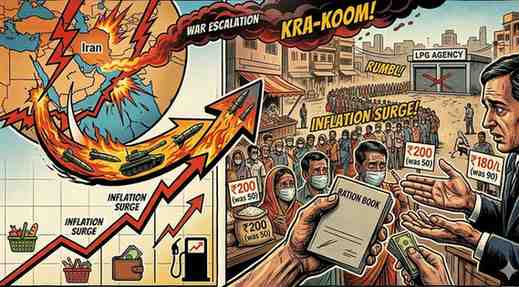
New Delhi, March 2026 — India’s economy is bracing for a significant shock as escalating conflict in the Middle East pushes wholesale inflation to new heights. Driven by a surge in input costs and a bottleneck in global trade routes, the average cost of running an Indian household is set to climb sharply. What began
New Delhi, March 2026 — India’s economy is bracing for a significant shock as escalating conflict in the Middle East pushes wholesale inflation to new heights. Driven by a surge in input costs and a bottleneck in global trade routes, the average cost of running an Indian household is set to climb sharply.
What began as a regional conflict in the Gulf has rapidly transformed into a domestic crisis for India, as the “hidden tax” of war begins to reflect in the price of everything from milk to electronics.
Wholesale Inflation: The Kitchen Budget Under Fire
India’s wholesale price inflation rose to 2.13% in February, a jump fueled largely by basic metals and manufactured goods. However, the most immediate impact is being felt in “primary articles”—the essentials that fill Indian plates.
Inflation for cereals, wheat, vegetables, milk, and eggs rose to 3.27%, up from 2.92% a year earlier. Families are finding that their monthly grocery budgets no longer stretch as far, even as economists warn that these prices are likely to climb further as the conflict prolongs.
The “Strait” of Delays: Freight Rates Skyrocket
The escalation of war between Iran and Oman has effectively choked the Strait of Hormuz, a critical artery for global trade. To avoid the crossfire, commercial ships are now taking much longer, costlier routes around Africa or through extended maritime paths.
The consequences for Indian industry are severe:
- Input Costs: Manufacturers are struggling with a surge in the price of crude oil derivatives, such as plastics and polymers.
- Delivery Timelines: The time taken for cargo to reach India from Europe has increased significantly, leading to a “gas shortage” that has already forced large restaurant chains to halt operations in parts of the country.
- Trade Disruptions: India’s exports and its landmark trade deal with the EU have faced massive delays, stalling economic growth projected for the quarter.
April Price Hikes: From Two-Wheelers to ACs
For the Indian middle class, the worst is yet to come. Major manufacturers have already flagged that prices for cars, two-wheelers, televisions, and air conditioners are expected to rise by 5% to 6% starting in April.
Automakers are particularly vulnerable, as component makers struggle to keep pace with rising costs and disrupted supply chains. With international freight rates remaining high and the rupee facing depreciation due to the war, these costs are being passed directly to the consumer.
A Prolonged Squeeze on the Consumer
Central banks, including the Federal Reserve, are expected to keep interest rates unchanged to combat this global inflationary pressure, meaning no relief is in sight for home or auto loans. As essential commodities, electronics, and fuel become costlier, the Indian household is being squeezed from both ends.
Bottom Line The conflict in the Gulf is no longer a distant news headline; it is a direct hit to the Indian wallet. From the dining table to the showroom floor, the “cost of war” is being paid by everyday consumers. As the Strait of Hormuz remains a flashpoint, the era of cheap goods and stable inflation appears to have vanished overnight.












Leave a Comment
Your email address will not be published. Required fields are marked with *