





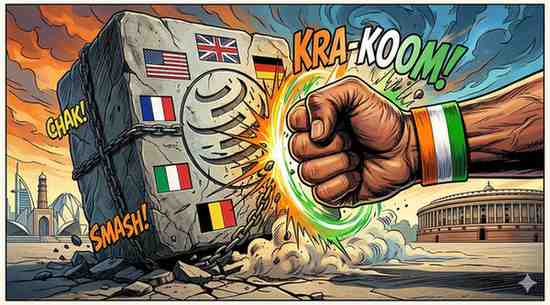
New Delhi, April 2026 — India has issued a stern warning to the World Trade Organization (WTO) and its member nations, cautioning that the international trade body risks becoming “irrelevant” if it continues to allow developed countries to bypass consensus-based decision-making. At the 14th Ministerial Conference in Cameroon, Indian Commerce Minister Piyush Goyal delivered a
New Delhi, April 2026 — India has issued a stern warning to the World Trade Organization (WTO) and its member nations, cautioning that the international trade body risks becoming “irrelevant” if it continues to allow developed countries to bypass consensus-based decision-making.
At the 14th Ministerial Conference in Cameroon, Indian Commerce Minister Piyush Goyal delivered a strong intervention, asserting that sovereign nations cannot be coerced into trade rules without their explicit consent.
The “Plurilateral” Threat to Global Trade
Traditionally, the WTO operates on a multilateral model where decisions require consensus from all members (“one country, one vote”). However, India highlighted a dangerous new trend: plurilateral agreements.
In this setup, a small group of powerful nations—led largely by the U.S. under the Trump administration—redefines trade rules among themselves and then attempts to impose them on the rest of the world. India argues this “rule-maker vs. rule-taker” dynamic undermines the democratic structure of global trade.
The Battle Over E-commerce and “Invisible” Taxes
A major point of contention is the 1998 moratorium on electronic transmissions. For decades, countries have agreed not to impose customs duties on digital goods like software and online games.
India and other developing nations now want to end this moratorium, arguing:
- Revenue Loss: Developing nations are massive consumers of digital products mostly created in the West.
- Unfair Advantage: The current rules allow developed nations to export digital goods duty-free, while developing nations lose out on significant tax revenue.
Defending the “Salt of the Earth”: Farmers and Food Security
India also locked horns with developed nations over agricultural subsidies. While the WTO seeks to limit domestic support for farmers, India insists on a permanent solution for Public Stockholding (PSH) for food security.
The government argued that it is hypocritical for developed nations—who have historically provided massive subsidies—to now prevent developing countries from protecting their own small-scale farmers and ensuring food for the poor.
The WTO in Crisis
The warning comes at a time when the WTO’s dispute settlement mechanism is already paralyzed. The U.S. has notably blocked the appointment of members to the Appellate Body, leaving no functional authority to hear complaints about trade violations or unfair tariffs.
India’s position is clear: if the WTO ceases to be a fair, inclusive forum that respects the sovereign rights of the Global South, the institution’s very foundation will crumble.
Bottom Line
India is positioning itself not as an “anti-WTO” player, but as the primary defender of a rule-based, inclusive system. By standing up against forced digital duties and agricultural restrictions, New Delhi is signaling that the era of Western-dictated trade terms is over.
















Leave a Comment
Your email address will not be published. Required fields are marked with *