
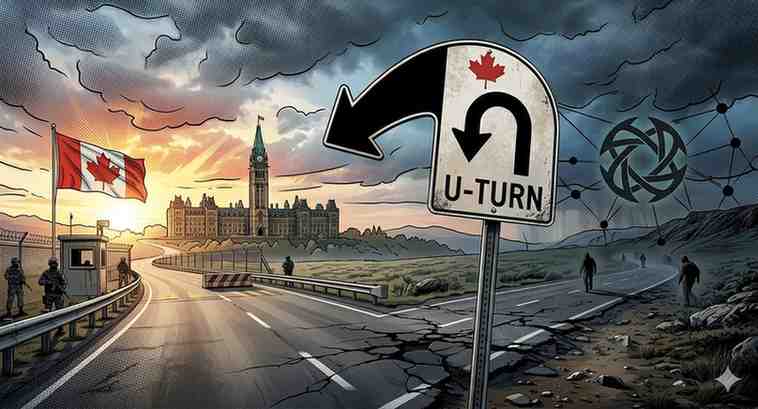
Ottawa, May 2026 — The Canadian government’s latest national security report has signaled a sharp “U-turn” in its stance on extremist networks. For years, Ottawa viewed these groups as a distant foreign policy headache for India; today, it officially labels them an “internal threat” to the sovereignty of Canada. This shift marks the end of
Ottawa, May 2026 — The Canadian government’s latest national security report has signaled a sharp “U-turn” in its stance on extremist networks. For years, Ottawa viewed these groups as a distant foreign policy headache for India; today, it officially labels them an “internal threat” to the sovereignty of Canada.
This shift marks the end of an era where political convenience overshadowed security warnings, revealing a “Bhasmasur” — a self-destructive force — that Canada spent years nurturing on its own soil.
From “Freedom of Speech” to National Threat
For nearly a decade, the Canadian government operated under a fog of “freedom of expression.” Despite dossiers and evidence from New Delhi regarding Khalistani extremist networks, the leadership prioritized vote-bank politics over preventative security.
The new official security report strips away these excuses. It admits that extremist networks, once dismissed as “seven seas away,” have become a cancer within Canada’s own borders. The terminology has shifted from “foreign issues” to “national security threats,” a silent admission that India’s long-standing warnings were accurate.
The Rise of Parallel Governance
The reality on the ground in provinces like British Columbia and Ontario has become impossible to ignore. These networks are no longer just about ideology; they have evolved into a sophisticated machinery of:
- Organized Crime & Gang Wars: Public shootouts in cities like Surrey and Brampton have exposed deep links between extremist ideology and local drug syndicates.
- Institutional Infiltration: Intelligence reports indicate that these groups have infiltrated local school boards, religious committees, and the lower rungs of municipal politics to manipulate public opinion.
- Civil Unrest: What was sold as “activism” has resulted in violent clashes near temples and community centers, splitting the Canadian social fabric into warring factions.
The Economic Reality Check
While security is the primary driver, the “U-turn” is also fueled by cold economic desperation. Canada is currently grappling with a severe cost-of-living crisis. Meanwhile, India has cemented its position as the world’s fastest-growing major economy.
Canadian leadership has realized that a “fictional narrative” set up by previous administrations is not worth losing access to the Indian market. From the Indo-Pacific strategy to global resource trade, Canada has found itself strategically isolated without India’s cooperation.
A Victory for Strategic Patience
This shift is a validation of India’s “New Bharat” diplomacy. Under External Affairs Minister S. Jaishankar, India refused to bow to public allegations, maintaining a firm stance that “business as usual” cannot exist alongside terrorism.
India’s strategic patience—using economic and diplomatic pressure rather than just rhetoric—has forced Canada to face its own intelligence files. The “U-turn” is not just a change of heart; it is a forced realization that you cannot protect a fire in your neighbor’s yard without eventually burning down your own house.
Bottom Line
The era of ignoring extremism for the sake of local votes is ending out of sheer necessity. However, trust is not built overnight. For New Delhi, the real test will not be Canada’s reports, but its actions: whether it will finally dismantle the funding, the safe havens, and the political space given to those who threaten the integrity of both nations.










Leave a Comment
Your email address will not be published. Required fields are marked with *