





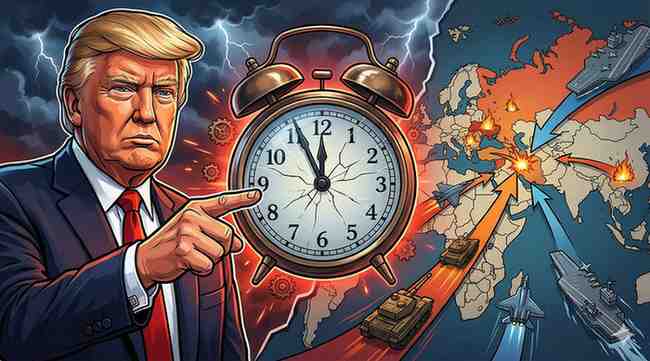
Washington D.C., April 2026 — The conflict between the United States and Iran has reached a critical flashpoint. President Donald Trump has issued a “final ultimatum” to Tehran, demanding an immediate agreement to a new deal and the reopening of the Strait of Hormuz by Tuesday. Failure to comply, the President warned, would result in
Washington D.C., April 2026 — The conflict between the United States and Iran has reached a critical flashpoint. President Donald Trump has issued a “final ultimatum” to Tehran, demanding an immediate agreement to a new deal and the reopening of the Strait of Hormuz by Tuesday. Failure to comply, the President warned, would result in “massive expanded military strikes” designed to “blow up whole Iran.”
This shift marks the transition into a second, more lethal phase of the war, as the U.S. prepares to deploy its most advanced long-range weaponry to break the current military deadlock.
The JASSM-ER: America’s “Invisible” Hammer
To back his rhetoric, the U.S. has positioned a massive stockpile of its most lethal long-range missiles for a potential strike. The weapon of choice is the JASSM-ER (Joint Air-to-Surface Standoff Missile – Extended Range).
Key specifications of this lethal missile include:
- Stealth Technology: Designed with a low radar cross-section, making it nearly impossible for Iranian defenses to intercept.
- Extreme Precision: Utilizes GPS and infrared seekers to hit targets within a few meters of accuracy.
- Standoff Range: With a range of 1,000 km, U.S. bombers can fire these from outside Iranian airspace, ensuring pilot safety.
Targeting the Economic and Military Backbone
The strategic logic behind this new phase is “Infrastructure Warfare.” Rather than just targeting military bases, the U.S. is now aiming for Iran’s logical and economic vitals:
- Energy Infrastructure: Oil refineries and export terminals like Kharg Island.
- Logistics: Key bridges and transport networks intended to paralyze domestic movement.
- Deep-Buried Assets: The JASSM-ER is capable of striking underground nuclear facilities and missile storage bunkers that were previously considered safe from conventional air raids.
Tehran’s Defiant Counter-Warning
Iran has dismissed Trump’s ultimatum as a sign of “helplessness” and “nervousness.” In a sharp retaliation, Iranian military officials warned that if the U.S. expands its strikes, the “Gates of Hell” will open.
Tehran’s strategy involves:
- Regional Spillover: Threatening the energy security of Gulf countries, which has already pushed global oil prices back above $110 per barrel.
- Asymmetric Retaliation: Utilizing proxy groups and “surprise attacks” that Iran claims will shock the international community.
A Global Crisis in the Making
The escalation has raised grave international concerns. Human rights groups warn of potential war crimes if civilian infrastructure is targeted, while global markets fear a permanent energy shock if the Strait of Hormuz remains closed.
As the Tuesday deadline looms, the next 24 to 36 hours will determine whether the region moves toward a fragile ceasefire via back-channel negotiations or plunges into a total, high-intensity regional war.
Bottom Line
The era of targeted skirmishes is over. With stealth cruise missiles positioned and a “blow up” directive issued, the U.S. is betting on maximum pressure to force a surrender. However, with Iran promising its own “surprises,” the world sits on the edge of a conflict that could easily spiral into a global catastrophe.


















Leave a Comment
Your email address will not be published. Required fields are marked with *