





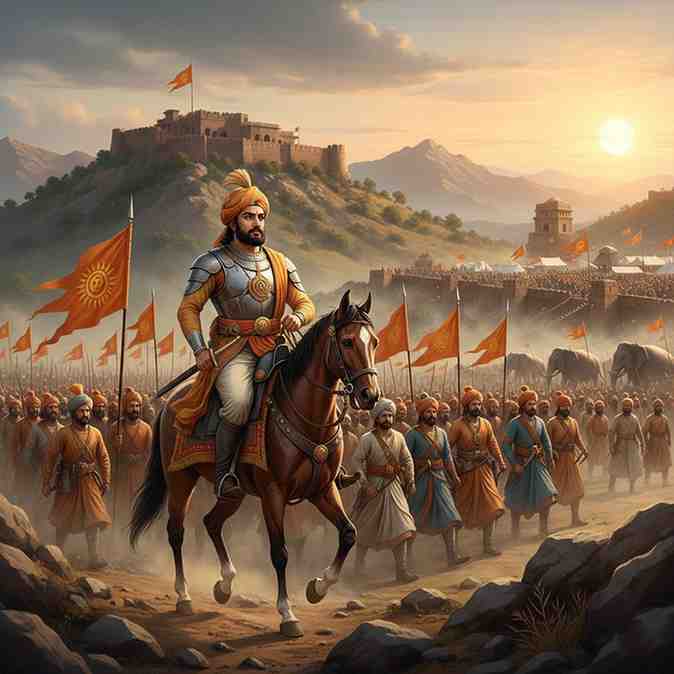
New Delhi, February 18, 2026 — Centuries before modern India’s struggle for independence, a revolutionary movement in the 17th-century Deccan plateau laid the foundation for a sovereign nation. This is the story of Chhatrapati Shivaji Maharaj, the “Father of the Indian Navy,” whose tactical brilliance and administrative foresight challenged the might of the Mughal Empire
New Delhi, February 18, 2026 — Centuries before modern India’s struggle for independence, a revolutionary movement in the 17th-century Deccan plateau laid the foundation for a sovereign nation. This is the story of Chhatrapati Shivaji Maharaj, the “Father of the Indian Navy,” whose tactical brilliance and administrative foresight challenged the might of the Mughal Empire at its peak.
Rising from the Sahyadris: Challenging Aurangzeb
In the mid-1600s, Mughal Emperor Aurangzeb was rapidly expanding his territory across the Indian subcontinent. However, his “expansionist agenda” faced its greatest obstacle in the Marathas. Utilizing the mountainous terrain and dense forests of the Western Ghats, Shivaji pioneered Guerrilla Tactics (Ganimi Kava). This allowed his smaller, highly mobile forces to decimate much larger, cumbersome Mughal armies through surprise raids and strategic retreats.
The Turning Point: The Defeat of Afzal Khan
One of the most legendary encounters in Indian history occurred in 1659 at the Battle of Pratapgarh. To suppress the rising Maratha power, the Bijapur Sultanate sent the cunning General Afzal Khan with a massive army. Suspecting a trap during a one-on-one diplomatic meeting, Shivaji wore hidden chainmail and concealed a weapon known as Wagh Nakh (Tiger Claws).
When Afzal Khan attempted to stab him during an embrace, Shivaji survived the blow and neutralized the General, leading to a decisive Maratha victory that sent shockwaves through the Deccan.
Administrative Excellence: The “Ashta Pradhan”
Shivaji Maharaj was not just a warrior but a visionary statesman. He established a sophisticated Council of Eight Ministers (Ashta Pradhan) to ensure a welfare-oriented state:
- Peshwa: The Prime Minister overseeing general administration.
- Sari-i-Naubat: The Commander-in-Chief of the military.
- Father of the Indian Navy: Recognizing the threat of foreign colonial powers (Portuguese, British, Dutch), he established a formidable naval force and strategic sea forts like Sindhudurg to protect the Konkan coast.
The Coronation and National Building
In 1674, Shivaji Maharaj was formally crowned at Raigad Fort, assuming the title of Chhatrapati. This was not merely a royal ceremony but a declaration of Hindavi Swarajya (Self-Rule). He replaced Persian with Marathi and Sanskrit in his court and introduced a standardized revenue system that protected peasants from exploitation, moving away from the feudal Jagirdari system.
Bottom Line
The era of Chhatrapati Shivaji Maharaj was never just about territorial conquest—it was about reclaiming dignity and establishing a state where the “Ryot” (common people) were the priority. His legacy of religious tolerance and social mobility created a blueprint for an empire that eventually controlled nearly two-thirds of the Indian subcontinent. Today, he remains a symbol of indigenous resistance and the eternal spirit of freedom.

















Leave a Comment
Your email address will not be published. Required fields are marked with *