
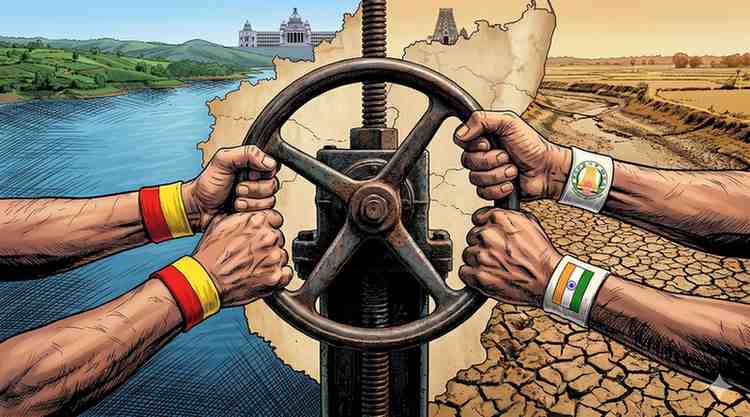
New Delhi, May 2026 — The century-old Cauvery water dispute between Karnataka and Tamil Nadu has flared up once again, highlighting the precarious nature of water security in South India. Driven by a weak monsoon season, the conflict has resurfaced with familiar intensity as both states clash over their respective shares of the vital river’s
New Delhi, May 2026 — The century-old Cauvery water dispute between Karnataka and Tamil Nadu has flared up once again, highlighting the precarious nature of water security in South India. Driven by a weak monsoon season, the conflict has resurfaced with familiar intensity as both states clash over their respective shares of the vital river’s water.
What was supposed to be a settled matter following a 2018 Supreme Court ruling has instead proven to be an ongoing flashpoint, particularly during “distress years” marked by deficient rainfall.
The Spark: A Demand for 24,000 Cusecs
The current crisis was triggered when Tamil Nadu demanded the release of 24,000 cusecs of water from Karnataka to support its agriculture. However, citing a weak monsoon and depleted reservoir levels, Karnataka, acting under the order of the Cauvery Water Regulation Committee, could only release 5,000 cusecs.
Dissatisfied, Tamil Nadu approached the Supreme Court. The apex court, however, refused to intervene, upholding the committee’s order for 5,000 cusecs. This decision has sparked protests, particularly from pro-Kannada organizations in Bengaluru, leading to heightened political tensions.
A River Stretched to Its Limits
Unlike other disputed South Indian rivers like the Krishna or Godavari, where conflicts often center on unused water, the Cauvery River is entirely fully utilized.
Originating in the Western Ghats at Talakaveri in Karnataka and flowing 800 kilometers through Tamil Nadu to the Bay of Bengal, the river sustains millions. The core issue is simple yet unresolvable: mathematics. The total demand from the four basin states stands at 1,139 TMC (Thousand Million Cubic feet), while the river’s average yield is only 740 TMC.
The Flaw in the Formula
The 2018 Supreme Court judgment created a somewhat smooth sharing arrangement for normal years. However, a critical loophole remains: neither the original tribunal nor the Supreme Court provided a clear formula for water utilization during “distress years” (years with poor rainfall) or “surplus years”.
When the rains fail, the pre-determined sharing ratios collapse, dragging the states back into a familiar cycle of demands, refusals, and legal appeals.
What Lies Ahead?
Experts emphasize that the conflict will only worsen unless fundamental changes are made. While legislative efforts like the Inter-State River Water Disputes Bill are steps in the right direction, they do not address the root cause.
Without significant improvements in agricultural practices and water-use efficiency, the states’ demands will continue to outpace the Cauvery’s finite supply, ensuring that this historic dispute remains a regular feature of South Indian politics.
Bottom Line
The Cauvery dispute is no longer just a legal battle; it is an ecological and mathematical crisis. With a river that is 100% utilized and a demand that far exceeds supply, the absence of a “distress year formula” ensures that every weak monsoon will resurrect this bitter interstate rivalry.












Leave a Comment
Your email address will not be published. Required fields are marked with *