
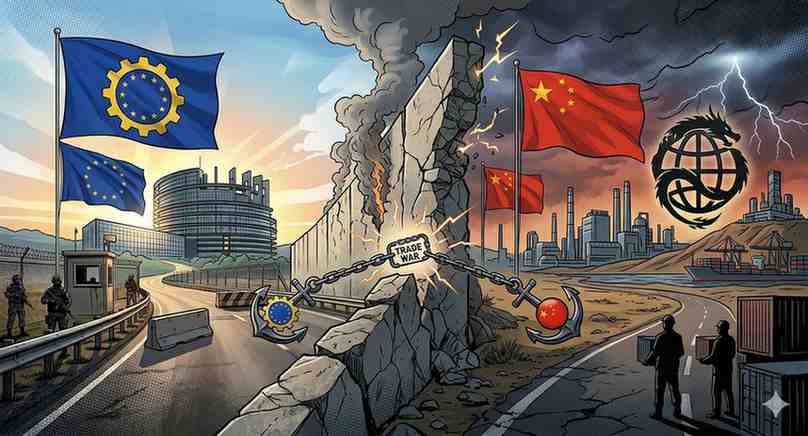
Brussels, May 2026 — The European Union has officially drawn a line in the sand with its aggressive new “Made in Europe” industrial plan, effectively ending an era of unchecked reliance on Chinese imports. What supporters call a necessary shield against unfair market domination, Beijing views as a hostile, discriminatory barrier that could spark a
Brussels, May 2026 — The European Union has officially drawn a line in the sand with its aggressive new “Made in Europe” industrial plan, effectively ending an era of unchecked reliance on Chinese imports.
What supporters call a necessary shield against unfair market domination, Beijing views as a hostile, discriminatory barrier that could spark a devastating global trade war.
The End of Free-Market Naivety For decades, the EU championed free trade, allowing market forces to dictate production. In reality, this open-door policy allowed heavily subsidized Chinese goods—from electric vehicles (EVs) to solar panels—to flood European markets, undercutting local manufacturers.
Now, the EU is shifting to a state-supported model. To counter the threat of mass job losses, the bloc will offer massive financial subsidies to domestic industries producing EVs, batteries, semiconductors, and renewable energy tech.
The Rules of the New Game The illusion of a level playing field is over. The EU has introduced strict mandates for foreign companies, directly targeting China’s export model:
- Forced Localization: Chinese firms wanting European subsidies can no longer simply export cheap goods; they must build factories and produce directly on European soil.
- Local Content Quotas: A significant percentage of product components (up to 40-60%) must be sourced locally from within Europe to qualify for market access.
- Anti-Dumping Tariffs: The EU will heavily penalize Chinese goods sold below production cost—a common tactic previously fueled by Beijing’s state subsidies.
Surviving “China Shock 2.0” Behind this drastic shift is a staggering $360 billion trade deficit that Europe holds with China. EU leaders are terrified of a “China Shock 2.0″—a repeat of the post-2000 era when cheap Chinese imports decimated America’s domestic manufacturing base. Furthermore, Europe aims to cut its dangerous strategic dependency on Beijing for critical technologies and rare earth minerals.
Beijing’s Retaliation Playbook For China, whose economic engine relies heavily on export-led manufacturing and low-cost global market access, losing unrestricted entry to the EU is a nightmare scenario.
Beijing has already issued stark warnings of countermeasures. Insiders predict retaliatory tariffs on European luxury goods, agricultural products, and automotive exports. More alarmingly, China could weaponize its supply chain dominance by restricting the export of vital rare earth minerals, holding Europe’s green transition hostage.
A Golden Window for India? As the world fragments into competing economic blocs, supply chains are rapidly reconfiguring. For India, this geopolitical rift presents a historic opportunity. With the EU actively seeking to fill the void left by restricted Chinese suppliers, India is perfectly positioned to boost its exports in textiles, electronics, and auto components, leveraging its recent trade alignments with Europe.
Bottom Line The “Made in Europe” mandate is more than just a trade policy; it signals the end of hyper-globalization. As economics becomes the new weapon of choice, the masks are off: the era of global free trade has officially yielded to the age of geoeconomics.












Leave a Comment
Your email address will not be published. Required fields are marked with *