
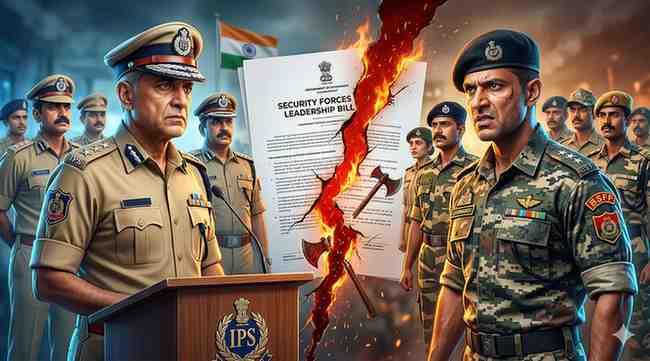
New Delhi, April 2026 — A massive human resources conflict is brewing at the heart of India’s security apparatus. A new law governing the Central Armed Police Forces (CAPF) has left thousands of cadre officers—the boots on the ground at borders and airports—fuming over what they call a “permanent glass ceiling.” The controversy centers on
New Delhi, April 2026 — A massive human resources conflict is brewing at the heart of India’s security apparatus. A new law governing the Central Armed Police Forces (CAPF) has left thousands of cadre officers—the boots on the ground at borders and airports—fuming over what they call a “permanent glass ceiling.”
The controversy centers on a fundamental question: Should the men and women who spend decades in the trenches be allowed to lead their own organizations, or are these top spots reserved only for the “elite” of the Indian Police Service (IPS)?
The Institutional “Glass Ceiling”
The new CAPF law, covering the CISF, CRPF, ITBP, and SSB, codifies a strict hierarchy that favors outsiders. According to the legislation, the most senior positions are effectively off-limits to internal officers:
- Director General & Special DG: 100% reserved for IPS officers.
- Additional DG: 67% reserved for IPS.
- Inspector General (IG): 50% reserved for IPS.
For a CAPF officer, the message is clear: no matter your talent, bravery, or experience, you will never be the chief—or even the second-in-command—of your own force.
The “Coordination” vs. “Class” Debate
The government justifies this structure by arguing that paramilitary heads must coordinate with state governments. They claim only the All India Service (IPS) has the necessary clout to liaise with state DGPs.
However, a more controversial sentiment lingers behind closed doors. There is a systemic suggestion that because CAPF officers do not take the same UPSC exam as the IPS, they are of a “different caliber.” Critics argue this is a classist outlook that ignores the specialized expertise required to manage border security and internal insurgency.
A Defiance of the Supreme Court?
What makes the officers particularly bitter is that they already won this battle in court. Last year, after a 20-year legal struggle, the Supreme Court ruled that IPS deputation should be progressively reduced to prevent “stagnation” among internal cadres.
Instead of following the spirit of that ruling, the new law reinforces the status quo. The only concession was a minor reduction at the Additional DG level—from 75% to 67%—which officers describe as a mere “drop in the ocean”.
The “Cushy Postings” Conflict
Data reveals a stark reality about where IPS officers choose to serve. While the CAPF is fighting on the frontlines, the top-tier IPS deputations are heavily skewed toward New Delhi.
In the CISF (which handles airport security), there are 16 IG-level posts. Out of the eight reserved for the IPS, six are currently stationed in Delhi. Despite the “coordination” excuse, zero IPS officers in these roles are posted in conflict-heavy states like Chhattisgarh or Bihar.
The Bottom Line
While other specialized “Group A” services—like the Revenue, Postal, or Audit services—are led by their own cadres, the paramilitary remains the outlier.
With the bill now passed by both houses of Parliament, the “salt of the earth” officers who secure India’s borders find themselves at a dead end. As the President prepares to sign the bill into law, the internal rift within India’s security forces is wider than ever, potentially leading to a new wave of legal battles and a crisis of morale in the ranks.












Leave a Comment
Your email address will not be published. Required fields are marked with *