
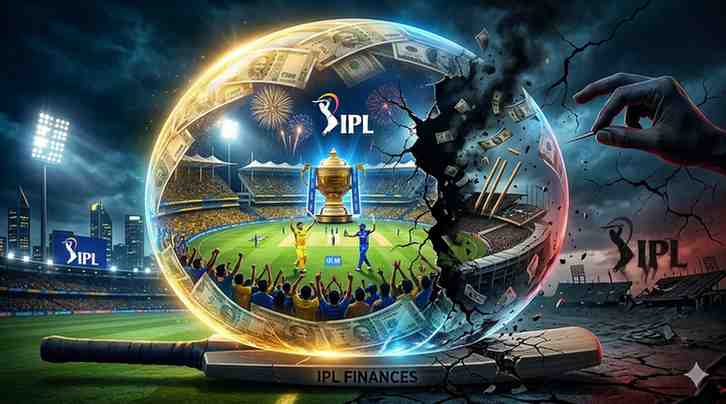
Mumbai, March 2026 — As the 2026 IPL season kicks off with its trademark fanfare, the league’s economy has reached a stratospheric milestone. However, the recent “financialization” of team ownership is raising urgent questions about whether the IPL has become a sustainable global powerhouse or a speculative bubble waiting to burst. What investors call a
Mumbai, March 2026 — As the 2026 IPL season kicks off with its trademark fanfare, the league’s economy has reached a stratospheric milestone. However, the recent “financialization” of team ownership is raising urgent questions about whether the IPL has become a sustainable global powerhouse or a speculative bubble waiting to burst.
What investors call a “once-in-a-lifetime asset,” skeptics describe as a market fueled by hyper-aggressive valuations that defy traditional revenue logic.
The Billion-Dollar Club: Valuations vs. Reality
The 2026 season was preceded by two historic sales that redefined the league’s worth. Royal Challengers Bangalore (RCB) was sold for a staggering $1.78 billion to a consortium including Blackstone and the Aditya Birla Group, while Rajasthan Royals (RR) fetched $1.63 billion.
The numbers are eye-watering: Rajasthan Royals has seen its value jump by over 2,000% in less than two decades. However, the disconnect lies in the “multiples.” While a healthy company might be valued at 5 or 10 times its revenue, RCB’s valuation is nearly 22 times its annual revenue of roughly ₹800 crore ($80 million). To justify such a price, the team must perform with a financial intensity that the current market may not support.
The Revenue Engine: A House Built on Media Rights
IPL teams are not traditional businesses; they are nodes in a central revenue pool. Their survival depends on four streams:
- The Central Pool (65–70% of income): Half of all media rights and central sponsorships sold by the BCCI are distributed equally among teams.
- Team Sponsorships: Direct brand deals for jersey and kit placement.
- Gate Receipts: Teams keep 80% of ticket sales from home matches.
- Merchandising: Sales of official fan gear.
The massive reliance on the “Central Pool” is the league’s greatest strength and its primary “Achilles’ heel.” If media rights values ever plateu, the entire billion-dollar valuation model collapses.
The Merger Threat: Losing the Bidding War
The biggest risk to the IPL economy is the recent consolidation of Indian media. Previously, a fierce bidding war between giants like Jio and Hotstar drove rights prices to record highs. With these entities now merging, the “competitive tension” is gone. In the next rights cycle (post-2027), the consolidated “Jio-Hotstar” entity could dictate lower prices, effectively slashing the primary revenue source for every team in the league.
Furthermore, the government’s crackdown on “Real Money Gaming” (fantasy apps) has removed a massive advertising segment that previously occupied nearly 70% of match airtime.
The “Greater Fool” and the Soft Power Play
Why would global giants like Blackstone pay $1.7 billion for a team earning $80 million? Two theories persist:
- The Soft Power Asset: Owning an IPL team provides “access.” It puts an investor in the same room as India’s elite and offers a direct line to a billion-person “religion.” It’s an influence play, not just a spreadsheet play.
- The Greater Fool Theory: Investors may be buying now simply because they believe someone else—perhaps a sovereign wealth fund—will pay $3 billion for the same seat in five years.
Expanding the Season: A Threat to the Sport?
To make these billion-dollar valuations “work,” owners are already pushing to elongate the IPL season. If the league expands from two months to six, it mirrors the NBA or NFL model. While this generates more cash, it threatens the “spirit” of the sport, potentially killing One-Day Internationals (ODIs) and Test cricket to make room for more franchise matches.
Bottom Line
The era of the “Billion-Dollar IPL” has arrived, but it is built on a high-stakes gamble. The valuations are currently running far ahead of the actual profits. Unless the league can find a way to grow without its traditional “gaming app” sponsors and amidst a media monopoly, the 2026 season might be remembered as the peak of a financial fever dream rather than a sustainable new reality.










Leave a Comment
Your email address will not be published. Required fields are marked with *