
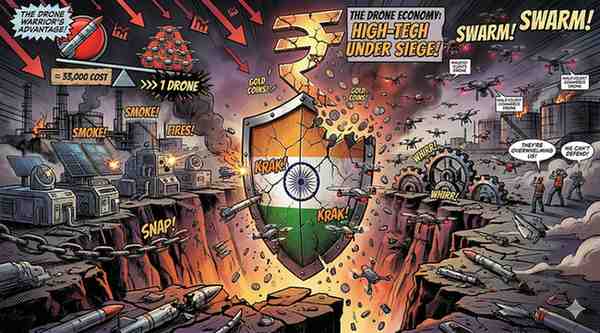
WASHINGTON D.C., March 2026 — A new era of warfare has arrived in the Middle East, and according to recent defense analyses, the U.S. and its allies are on the losing side of a critical economic equation. Iran’s “bullock cart” drones—cheap, slow, and expendable—are successfully depleting the billion-dollar missile stockpiles of the world’s most advanced
WASHINGTON D.C., March 2026 — A new era of warfare has arrived in the Middle East, and according to recent defense analyses, the U.S. and its allies are on the losing side of a critical economic equation. Iran’s “bullock cart” drones—cheap, slow, and expendable—are successfully depleting the billion-dollar missile stockpiles of the world’s most advanced militaries.
The “Price-Tag” Imbalance
The core of the problem lies in a staggering cost disparity. Iran’s battle-tested Shahed drones are manufactured using aluminum composites and commercial off-the-shelf components, costing approximately $20,000 each. In contrast, the high-tech interceptor missiles used by the U.S., Israel, and Gulf States can cost up to $4 million per shot.
When Iran launches these drones in swarms of hundreds, they effectively “wipe out” defensive stockpiles. “War is nothing but a money game,” notes military analyst Abishek Singh, highlighting that the cost ratio for an interception can reach an unsustainable 70-to-1 in Iran’s favor.
The $11 Billion Week
The financial toll is already surfacing in official briefings. Reports indicate that in the first six days of operations alone, war costs exceeded $11.3 billion. In just the first 48 hours, roughly $5.6 billion worth of munitions were fired.
The math is brutal: a single THAAD interceptor battery costs $1.5 billion, and each individual interceptor costs $15 million. This makes defending against a $20,000 drone a losing proposition for any treasury.
Searching for a “Cost-Effective” Shield
To counter this, the U.S. and Israel are pivoting toward Directed Energy Weapons (DEW) and AI-powered shields:
- Iron Beam: Israel’s laser system reportedly costs just $3.50 per shot, though its full operational reliability in diverse weather like fog or dust remains unproven.
- HELIOS: The U.S. Navy’s 60 kW laser weapon can fry drone sensors or physically destroy them with heat, offering a low-cost alternative to traditional missiles.
Lessons from the Ukrainian Front
While the West searches for high-tech solutions, Ukraine has already pioneered a low-cost counter-strategy. By using interceptor drones like the “Sting” (costing $2,000–$4,000) and “MEROPS” ($10,000–$15,000), Ukraine has achieved interception rates exceeding 85%. Gulf states have reportedly expressed strong interest in adopting these Ukrainian tactics to plug their own defensive gaps.
Bottom Line
The current strategy of using “shiny, high-tech missiles” to stop “cheap drones” is a fiscal dead end. Unless the U.S. and its allies can rapidly deploy cost-effective laser or interceptor-drone technology, they risk becoming “sitting ducks” once their expensive missile stockpiles are exhausted.











Leave a Comment
Your email address will not be published. Required fields are marked with *