
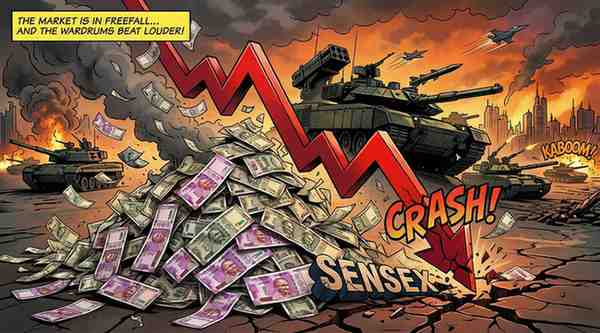
Mumbai, March 2026 — In a staggering blow to the Indian financial markets, investors lost more than ₹14 lakh crore on Monday as the benchmark indices suffered their second consecutive “Bloody Monday.” The Sensex crashed by 1,836.57 points (2.46%), while the Nifty 50 settled at an 11-month low of 22,512.65 points. This massive sell-off highlights
Mumbai, March 2026 — In a staggering blow to the Indian financial markets, investors lost more than ₹14 lakh crore on Monday as the benchmark indices suffered their second consecutive “Bloody Monday.” The Sensex crashed by 1,836.57 points (2.46%), while the Nifty 50 settled at an 11-month low of 22,512.65 points. This massive sell-off highlights the growing anxiety over the West Asia conflict, which has now entered its fourth week with no clear resolution in sight.
Crude Oil and Inflation: The Twin Pressures
The primary catalyst for the market meltdown is the relentless surge in energy prices. Brent crude rose by 62% to hit $112.9 per barrel, consistently hovering above the $110 mark. For India, as one of the world’s largest oil importers, these prices pose a severe threat to the domestic economy.
Analysts warn that persistently high oil prices are fueling inflation and widening external imbalances. The fear of potential retaliation and threats related to the Strait of Hormuz—a critical artery for global energy supplies—has heightened concerns over severe supply disruptions.
FPI Exodus and Rupee at Record Lows
The market was further weighed down by sustained foreign fund outflows. Foreign Portfolio Investors (FPIs) have been net sellers throughout March, offloading a staggering ₹1 lakh crore since the Iran war began. This mass exit is driven by global uncertainty and the pursuit of safer assets, such as the US Dollar, elsewhere.
This capital flight, combined with rising crude costs, pushed the Indian Rupee to a record low of 93.94 against the US dollar in early trade. The currency’s weakness has added another layer of pressure on domestic equities and pushed bond yields higher, reflecting domestic and global stress.
Banking Stocks and Volatility Surge
The carnage was visible across blue-chip stocks, particularly in the banking sector. HDFC Bank fell by approximately 2.5%, while State Bank of India (SBI) dropped 3.6%. Amidst this sell-off, the Volatility Index (VIX) surged by 17 points, reaching its highest level since June 2024, signaling that investors expect the near-term turbulence to continue.
Bottom Line
The Indian markets are currently trapped in a perfect storm of geopolitical conflict, inflationary pressure, and record currency depreciation. Analysts point out that the lack of clarity on the duration and outcome of the US-Iran conflict has kept markets “on edge”. For the retail investor, the era of stable returns has been replaced by a period of extreme caution as global energy and financial maps are redrawn by conflict.












Leave a Comment
Your email address will not be published. Required fields are marked with *