
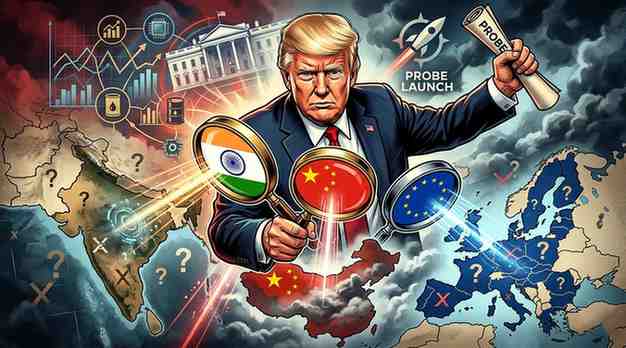
Washington, March 2026 — U.S. President Donald Trump has vowed to bypass a major Supreme Court setback, asserting his “absolute right” to reimpose sweeping tariffs on global imports. The move signals a new era of trade volatility, with the administration already launching fresh investigations into major economies, including India. What the President calls a defense
Washington, March 2026 — U.S. President Donald Trump has vowed to bypass a major Supreme Court setback, asserting his “absolute right” to reimpose sweeping tariffs on global imports. The move signals a new era of trade volatility, with the administration already launching fresh investigations into major economies, including India.
What the President calls a defense of American industry, the judiciary has termed an executive overreach. The resulting legal and political standoff is set to redefine U.S. trade relations just months before the midterm elections.
The Supreme Court Standoff
In a landmark 6-3 ruling this February, the U.S. Supreme Court struck down Trump’s “reciprocal tariffs,” which had imposed duties ranging from 10% to 50% on various imports. The Court ruled that the President exceeded his authority under the International Emergency Economic Powers Act, effectively invalidating the “Liberation Day” tariffs.
The ruling has opened a massive financial hole, allowing importers to seek refunds on approximately $166 billion in duties already collected. Trump has been scathing in his criticism of the decision, labeling it a “gift to foreign nations” while praising the conservative justices who dissented for their “wisdom and courage”.
India and China in the Crosshairs
Despite the judicial defeat, the Trump administration is not backing down. The Office of the U.S. Trade Representative (USTR) has launched a fresh “unfair trade practices” investigation targeting 16 major economies, including India, China, the European Union, and Mexico.
The new probe focuses on “excessive industrial capacity,” specifically targeting countries that maintain manufacturing outputs far exceeding their domestic demand. U.S. officials are examining several factors they believe give these nations an unfair advantage:
- Government Subsidies and state-owned enterprise activity.
- Currency Practices and suppressed wages.
- Weak Environmental and Labor Standards that lower production costs.
The Path Forward: Section 301 and Summer Deadlines
Analysts believe the administration is pivoting to a “Section 301” probe to justify more targeted, legally secure tariffs by this summer. This strategy aims to keep pressure on trade partners like India while avoiding the broad legal pitfalls that led to the Supreme Court’s intervention.
Trade Representative Jameson Grier indicated that the government hopes to recommend these new remedies before current temporary tariffs expire in July. With midterms approaching, the push for tariffs is seen as a key political maneuver to convince the electorate of the President’s commitment to “America First” economics.
Bottom Line
The era of predictable trade is over. By challenging the Supreme Court and opening new fronts against partners like India, President Trump is betting that aggressive protectionism remains his strongest political asset. For global markets and Indian exporters, the message is clear: the U.S. tariff wall is being rebuilt, one legal loophole at a time.












Leave a Comment
Your email address will not be published. Required fields are marked with *