





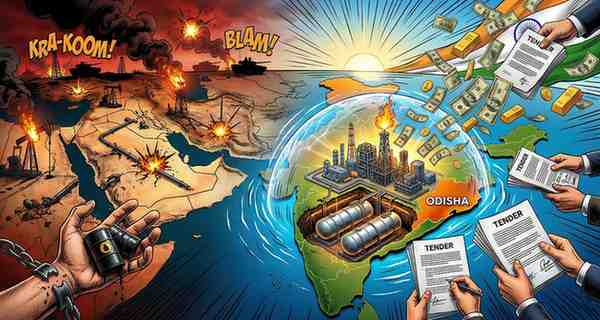
New Delhi/Bhubaneswar, March 2026 — As the conflict in West Asia threatens global energy corridors, India is accelerating its mission to bolster its energy security. The Indian Strategic Petroleum Reserve Limited (ISPRL) is set to float a major tender by the end of April for a massive crude storage facility in Chandikol, Odisha. The project
New Delhi/Bhubaneswar, March 2026 — As the conflict in West Asia threatens global energy corridors, India is accelerating its mission to bolster its energy security. The Indian Strategic Petroleum Reserve Limited (ISPRL) is set to float a major tender by the end of April for a massive crude storage facility in Chandikol, Odisha. The project is estimated to cost approximately $1 billion for construction alone, with an additional $3 billion required to fill the reserve with crude oil.
The urgency comes as disruptions in the Strait of Hormuz put nearly 40% of India’s crude supplies at risk. With India importing close to 90% of its oil, the economy remains highly vulnerable; even a $1 increase per barrel significantly inflates the national import bill.
Expanding the Buffer: Odisha and Karnataka
Prime Minister Narendra Modi recently informed the Lok Sabha that India is moving ahead with plans to add 6.5 million tons of additional crude reserves. This expansion includes:
- Chandikol, Odisha: A 4-million-ton capacity facility.
- Padur, Karnataka: A 2.5-million-ton facility being fast-tracked under India’s first public-private partnership (PPP) model for strategic reserves. Hyderabad-based Megha Engineering has already secured the work order for this site.
The Padur facility is designed to be a comprehensive hub, featuring underground storage, offshore pipelines, and a dedicated single-point mooring system for efficient crude handling.
The Race Against Time and Cost
Currently, India’s strategic reserves stand at over 5 million tons, but only about two-thirds of that capacity is currently filled and available as a buffer. While the new projects are vital, experts warn they are not a quick fix. Construction and operationalization could take up to seven years.
Furthermore, building and filling reserves when global oil prices are already high presents a financial challenge. Strategic reserves are most economically effective when filled during periods of low prices, yet India must now balance long-term security against current market volatility.
Bottom Line
With 40% of its supply lines under threat, India’s “just-in-time” push for the Chandikol and Padur reserves is a high-stakes attempt to insulate the domestic economy from external shocks. As the government explores six additional storage locations, the focus remains on whether these shields can be raised before the next major global energy disruption.

















Leave a Comment
Your email address will not be published. Required fields are marked with *