





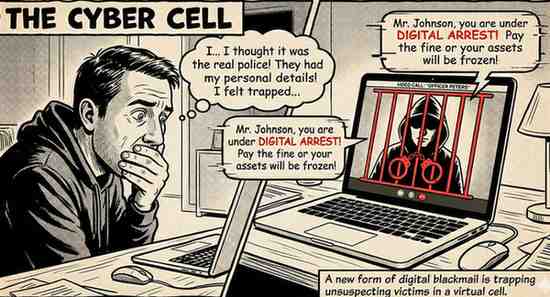
New Delhi, November 2024 — A terrifying new form of cybercrime known as “Digital Arrest” is sweeping across India, turning smartphones into virtual prison cells. Unlike traditional phishing, this scam uses extreme psychological pressure, forged legal documents, and simulated government offices to extort lakhs of rupees from unsuspecting victims, often leaving them traumatized for weeks.
New Delhi, November 2024 — A terrifying new form of cybercrime known as “Digital Arrest” is sweeping across India, turning smartphones into virtual prison cells. Unlike traditional phishing, this scam uses extreme psychological pressure, forged legal documents, and simulated government offices to extort lakhs of rupees from unsuspecting victims, often leaving them traumatized for weeks.
The “Illegal Parcel” Bait
The scam typically begins with a cold call, often claiming to be from a reputed courier service like FedEx or Blue Dart.
- The Allegation: The victim is told that a parcel sent in their name has been intercepted by authorities.
- The Contraband: Scammers claim the package contains illegal items—such as MDMA (drugs), expired passports, or unauthorized credit cards—linked to international money laundering syndicates.
- The Transfer: To “verify” the victim’s identity, the call is “transferred” to a fake police officer or a CBI official via Skype or WhatsApp video.
Simulating the “CBI Office”
The video report highlights the chilling level of production quality used to build trust. Scammers set up elaborate home studios that look identical to high-ranking police stations or CBI offices.
- Visual Deception: Fraudsters wear authentic-looking uniforms, display forged ID cards, and use background noises of wireless sets and office chatter to create a high-stress environment.
- The “Gag Order”: Victims are told they are under “Digital Arrest” and are forbidden from ending the video call, talking to family members, or leaving their rooms. They are monitored 24/7 through their camera, effectively being held hostage in their own homes.
The “Security Deposit” Extraction
Once the victim is sufficiently terrified of facing jail time, the scammers offer a “way out.”
- The Investigation Fee: They claim the victim’s bank accounts must be “verified” by the Reserve Bank of India (RBI) to prove the funds are not “black money.”
- The Transfer: Victims are coerced into transferring their entire savings into “government-monitored” accounts, with the false promise that the money will be returned within 30 minutes once cleared.
- The Disappearance: The moment the funds reach the scammers’ mule accounts, the “officers” vanish, the video calls are disconnected, and the victims are left with empty bank accounts and a shattered sense of security.
The Toll on Senior Citizens and Professionals
The investigative breakdown reveals that the primary targets are often retired professionals and senior citizens who are less familiar with modern digital forgery but highly respectful of law enforcement.
- The Impact: Losses often range from ₹10 lakh to over ₹2 crore in a single incident.
- The Scale: The National Cyber Crime Reporting Portal has seen a massive surge in these cases, with the Prime Minister recently addressing the issue in Mann Ki Baat, urging citizens to “Stop, Think, and Act.”
How to Break the “Digital Arrest”
Experts featured in the video emphasize three non-negotiable facts:
- No Law Enforcement Conducts “Digital Arrests”: The police, CBI, or ED will never investigate you over a WhatsApp or Skype video call.
- Arrests are Physical, Not Digital: Legal procedures require physical presence and a warrant; they never involve transferring money for “verification.”
- The Power of Disconnect: If someone threatens you with “Digital Arrest,” immediately hang up and report the number on the Chakshu portal or dial 1930.
Bottom Line
The “Digital Arrest” is not a legal process—it is a high-tech extortion racket fueled by fear. The video serves as a critical warning: the police don’t call you to “verify” your money; they come to your door if there is a crime. In the digital age, your biggest defense against a scammer is the courage to hit the “End Call” button.




















Leave a Comment
Your email address will not be published. Required fields are marked with *