





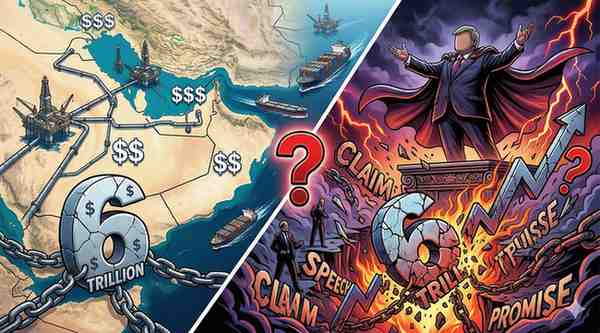
WASHINGTON D.C. — President Donald Trump has sparked a fresh wave of economic debate following his recent claims of securing a staggering $6 trillion in investment deals from Saudi Arabia, Qatar, and the United Arab Emirates (UAE). While the President frames these agreements as a historic windfall for the American economy, financial analysts and regional
WASHINGTON D.C. — President Donald Trump has sparked a fresh wave of economic debate following his recent claims of securing a staggering $6 trillion in investment deals from Saudi Arabia, Qatar, and the United Arab Emirates (UAE). While the President frames these agreements as a historic windfall for the American economy, financial analysts and regional experts are raising red flags over the math.
The $6 Trillion Claim vs. The $2 Trillion Reality
During a series of public addresses, Trump asserted that his diplomatic efforts resulted in a three-way split of massive commitments. “I came back with two trillion from Saudi, two trillion from Qatar, and two trillion from UAE,” he stated, suggesting an immediate pivot by these nations toward U.S. interests.
However, a closer look at the May 2025 summits tells a different story. Detailed reports indicate the actual announced totals hover around $2 trillion—a significant sum, but only a third of the President’s claim. The breakdown includes $600 billion from Saudi Arabia, $1.2 trillion from Qatar, and roughly $200 billion in new UAE deals.
The “Paper Deal” Problem: MoUs vs. Hard Cash
The discrepancy isn’t just in the total figure, but in the nature of the deals themselves. Financial experts point out that a large portion of these announcements consists of non-binding Memorandums of Understanding (MoUs) rather than finalized contracts.
- Qatar’s $1.2 Trillion: Described by officials as a broad “economic exchange,” many of these figures lack concrete project details.
- The “Nothing Concrete” Admission: A Qatari official recently admitted that a $500 billion segment of their pledge currently has no specific roadmap for implementation.
- Historical Precedent: Following a similar 2017 visit where $450 billion was touted, official U.S. statistics showed that actual direct Saudi investment rose by a mere $5 billion by the end of 2024.
A Mathematical Improbability?
Economists have highlighted a glaring inconsistency between Trump’s claims and the actual size of the Gulf economies. The combined annual GDP of Saudi Arabia (~$1.2 trillion), the UAE (~$500 billion), and Qatar totals approximately $3 trillion.
For these nations to commit $6 trillion—double their combined annual economic output—would be a fiscal impossibility without total economic exhaustion. Analysts suggest the figures being cited likely include long-term purchase agreements for Boeing aircraft and defense contracts spread over decades, rather than a “massive cash infusion” available today.
Political Theater or Economic Strategy?
Critics argue that these inflated numbers serve a domestic political purpose, painting a picture of “America First” success that isn’t reflected in the ledger. While the deals do represent genuine interest in U.S. tech and defense sectors, experts warn that many of these “mega-deals” are often shelved or quietly scaled back once the media spotlight fades.
Bottom Line
The narrative of $6 trillion flooding into the U.S. appears to be an “illusion economy.” While the Gulf nations remain vital trade partners, the gap between the President’s rhetoric and the documented $2 trillion in uncertain agreements suggests that, in this instance, the art of the deal may involve a significant amount of creative accounting.


















Leave a Comment
Your email address will not be published. Required fields are marked with *