




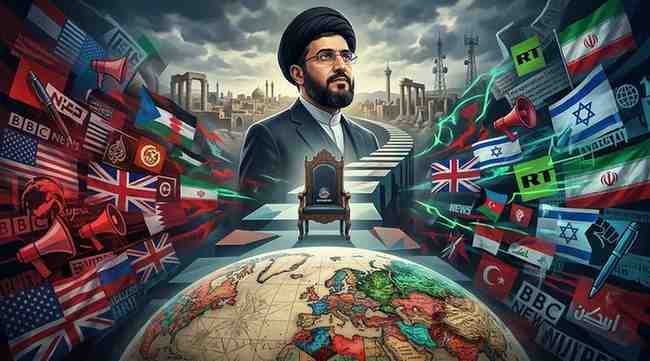
Tehran, March 11, 2026 — One week after the assassination of Supreme Leader Ayatollah Ali Khamenei, Iran has defied expectations of a leadership vacuum by appointing his 56-year-old son, Mojtaba Khamenei, as his successor. The move signals a hardline message of continuity to the West, even as the United States’ “Operation Epic Fury” enters a
Tehran, March 11, 2026 — One week after the assassination of Supreme Leader Ayatollah Ali Khamenei, Iran has defied expectations of a leadership vacuum by appointing his 56-year-old son, Mojtaba Khamenei, as his successor. The move signals a hardline message of continuity to the West, even as the United States’ “Operation Epic Fury” enters a period of severe political and economic backlash.
The appointment marks a historic shift for the Islamic Republic, transforming the leadership into a hereditary role—a move that many argue betrays the anti-monarchy spirit of the 1979 Revolution.
The Enigma of Mojtaba: Hidden Power and Global Assets
Mojtaba Khamenei has long operated within “hidden power networks.” Unlike his brothers, who took administrative or cultural roles, Mojtaba embedded himself within the IRGC (Islamic Revolutionary Guard Corps), serving in the same battalion that trained the late Qasem Soleimani.
He is already a target of heavy Western sanctions. Investigative reports estimate his global economic ecosystem—comprising properties in London, Dubai, and Frankfurt—is worth billions of dollars, contrasting sharply with the economic hardship and inflation currently strangling the Iranian public.
Trump’s Three Fault Lines: Promise, Pretext, and Plan
While Tehran solidifies its leadership, President Donald Trump faces a growing “war of narratives” at home, characterized by three critical fault lines:
- The Broken Promise: Trump campaigned on a “no new wars” platform in 2024. However, the current conflict has already resulted in American service member fatalities, alienating voters who sought an end to “foolish neverending foreign wars”.
- The Shifting Pretext: The administration’s justification for the war has been inconsistent. Trump cited a “feeling” of an imminent strike, while the Secretary of State argued that the U.S. was forced into a preemptive action because an Israeli attack was inevitable.
- The Unclear Plan: U.S. objectives—destroying missiles and the Iranian navy—did not originally account for the death of the Supreme Leader or the tragic bombing of a school in southern Iran that reportedly killed 175 civilians.
Economic Fallout and Midterm Anxiety
The war is proving to be an economic burden. Oil prices have surged to $100 a barrel, and the Pentagon has reportedly spent $6 billion in just the first week of the conflict. This has triggered a political crisis for Vice President JD Vance, whose 2028 aspirations are now tied to a war that contradicts his “America First” non-interventionist stance.
Current polling shows that 37% of Americans strongly disapprove of the war, a figure that poses a significant threat to the Republican “trifecta” (control of the White House, House, and Senate) in the upcoming midterm elections.
Bottom Line
The appointment of Mojtaba Khamenei indicates that Trump’s objective of regime change has effectively failed; instead of a collapse, the Iranian establishment has doubled down on hardline continuity. As oil prices climb and political backlash intensifies, the White House is left searching for an exit plan that provides “many years of peace” without looking like a retreat.

















Leave a Comment
Your email address will not be published. Required fields are marked with *