





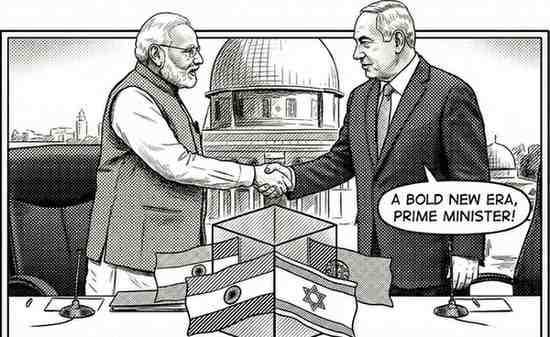
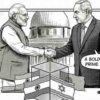
Jerusalem, February 2026 — Prime Minister Narendra Modi’s landmark visit to Israel has unveiled a new era of geopolitical architecture, centered on Benjamin Netanyahu’s ambitious “Hexagon of Alliances.” The visit, marking nearly a decade since Modi’s last trip to the country, transcends simple bilateral diplomacy. At its heart is a proposed strategic network that aims
Jerusalem, February 2026 — Prime Minister Narendra Modi’s landmark visit to Israel has unveiled a new era of geopolitical architecture, centered on Benjamin Netanyahu’s ambitious “Hexagon of Alliances.”
The visit, marking nearly a decade since Modi’s last trip to the country, transcends simple bilateral diplomacy. At its heart is a proposed strategic network that aims to redefine security and economic connectivity across Asia, the Middle East, and the Mediterranean.
The “Hexagon” Blueprint: A Multilateral Web
The “Hexagon of Alliances” is envisioned not as a rigid military bloc like NATO, but as a flexible, networked alliance of six key strategic partners. Benjamin Netanyahu has identified India as the “crucial node” of this structure.
The primary objectives of the Hexagon include:
- Security Coordination: Strengthening intelligence sharing and joint defense.
- Economic Corridors: Expanding connectivity, potentially linking with projects like the India-Middle East-Europe Economic Corridor (IMEC).
- Reducing Global Dependency: Creating a multi-regional alliance that operates independently of traditional single-power dependencies, specifically moving toward a more autonomous security footprint.
From Buyer-Seller to Strategic Co-Producers
For years, the India-Israel relationship was defined by commerce—India was a primary buyer of Israeli drones, missiles, and surveillance technology. This visit signals a tectonic shift toward co-production and technology transfer.
The 2026 agenda focuses on “Joint Weapon Development,” where the two nations will build high-tech defense systems together rather than India simply purchasing them off the shelf. This “Strategic Partnership” is reinforced by the strong personal rapport between PM Modi and PM Netanyahu, a relationship that has historically bypassed bureaucratic hurdles.
The De-Hyphenation Masterstroke
One of the most significant policy shifts highlighted during this visit is India’s finalized “De-hyphenation” strategy. Traditionally, Indian leaders would visit Israel and Palestine in tandem to maintain a diplomatic balance.
Today, India handles its relationships with both nations on independent tracks. PM Modi can address the Israeli Parliament (Knesset) and engage in deep military cooperation without compromising India’s separate commitment to a two-state solution for the Palestinian people.
Strategic Autonomy vs. Regional Risks
While the Hexagon offers India a seat at a powerful new table, it is not without peril. Analysts warn that formalizing such an alliance could:
- Strain Iran Relations: Any Israel-centric security bloc is viewed with suspicion by Tehran.
- Wary Arab Partners: Despite the Abraham Accords, certain Arab nations remain cautious about a dominant Israeli security network.
- The Russian Factor: India must balance this new West-Asian tilt with its long-standing strategic ties to Moscow.
Bottom Line
The visit confirms that India is no longer just a participant in Middle Eastern affairs but a foundational architect of its future. By positioning India as a “crucial node” in the Hexagon, Israel is betting on India’s economic and military weight to balance regional power. For New Delhi, the challenge remains maintaining its “strategic autonomy” while entering a network that is explicitly security-focused and transformative.

















Leave a Comment
Your email address will not be published. Required fields are marked with *