





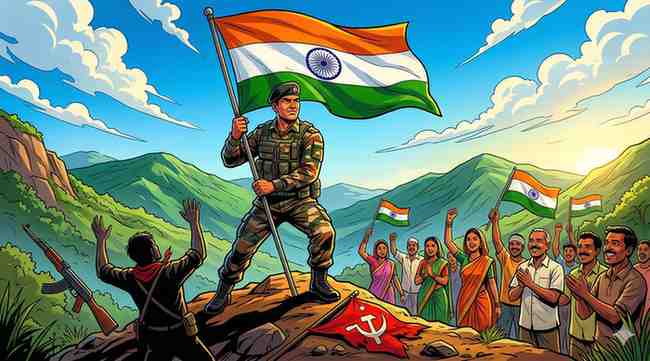
NEW DELHI, March 2026 — In a historic declaration from the floor of Parliament, Union Home Minister Amit Shah has announced that India is now officially “Naxal-free.” The statement marks the conclusion of a decades-long struggle against an insurgency that was once labeled by former Prime Minister Manmohan Singh as the nation’s “greatest internal security
NEW DELHI, March 2026 — In a historic declaration from the floor of Parliament, Union Home Minister Amit Shah has announced that India is now officially “Naxal-free.” The statement marks the conclusion of a decades-long struggle against an insurgency that was once labeled by former Prime Minister Manmohan Singh as the nation’s “greatest internal security threat.”
The Fall of the Red Corridor
For over half a century, the “Red Corridor”—a swathe of territory stretching from West Bengal to Andhra Pradesh—operated as a state within a state. At its peak, Maoist insurgents controlled dense forest pockets, ran parallel judicial systems, and collected “revolutionary taxes” from local populations.
The epicenter of this resistance, the Bastar region in Chhattisgarh, was long considered a “no-go zone” for government officials. However, latest reports indicate that over 96% of this territory has been cleared, with the shadow of the “Red Terror” finally lifting from the tribal heartlands.
A Strategy of “Bullets and Benefits”
The government’s victory was not achieved through military might alone, but through a calculated four-pillar strategy that dismantled the movement from the inside out:
- Security Saturation: Elite units like the CoBRA commandos and CRPF utilized drone surveillance and intelligence-led strikes to neutralize top-tier leadership and shrink the insurgent cadre.
- The Surrender Pipeline: Thousands of Maoists laid down their arms between 2023 and 2026, drawn by rehabilitation packages that offered cash rewards, housing, and job training.
- Infrastructure as a Weapon: By building roads, mobile towers, and schools in “liberated” zones, the state bridged the trust gap, effectively cutting off the insurgents’ recruitment base.
- Governance Penetration: The replacement of “People’s Courts” with legitimate Panchayats and police stations ensured the return of constitutional law to the jungles.
Ideology vs. Poverty: The Political Flashpoint
While the announcement is a security triumph, it has sparked a fierce ideological debate. Minister Shah challenged the long-held belief that Naxalism was a byproduct of poverty, asserting instead that it was an “ideological indoctrination” rooted in Marxism-Leninism-Maoism.
The Home Minister further ignited controversy by linking the movement’s historical growth to the 1970s, alleging that the “Left-leaning” policies of past administrations created a fertile ground for extremism to thrive. Critics, however, argue that while the violence has ended, the root causes—such as land alienation and tribal exploitation—must be continuously addressed to prevent a resurgence.
Beyond the Gun: The Road Ahead
The declaration of a “Naxal-free India” is a monumental milestone, but experts warn that the battle of ideas remains. While the “armed struggle” has collapsed, the government now faces the challenge of ensuring that the development in these regions is sustainable and inclusive.
Bottom Line: The era of the “Red Corridor” has ended not just because of tactical superiority, but because the state finally showed up where it had been absent for 60 years. For the residents of Bastar and beyond, the goal is no longer survival against insurgents, but integration into the modern Indian economy.



















Leave a Comment
Your email address will not be published. Required fields are marked with *