





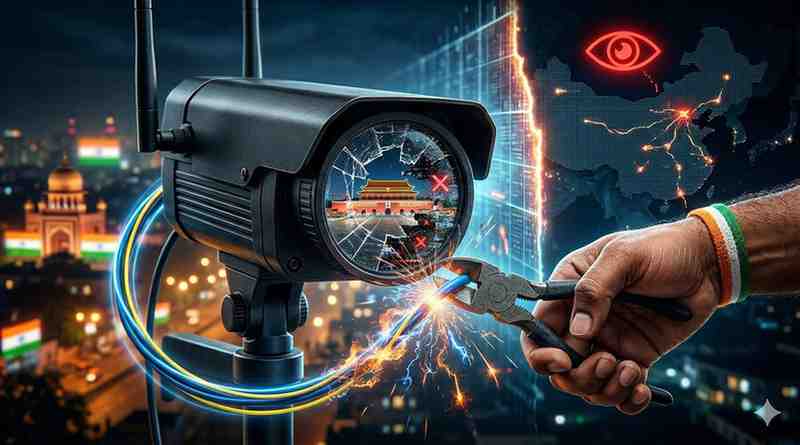
New Delhi, April 2026 — The silent digital war between New Delhi and Beijing has moved from mobile apps to the very walls of Indian homes and offices. As of April 1, 2026, the Indian government has effectively ended the dominance of Chinese CCTV giants like Hikvision and Dahua, implementing a certification regime that acts
New Delhi, April 2026 — The silent digital war between New Delhi and Beijing has moved from mobile apps to the very walls of Indian homes and offices. As of April 1, 2026, the Indian government has effectively ended the dominance of Chinese CCTV giants like Hikvision and Dahua, implementing a certification regime that acts as a “death warrant” for hardware with Chinese DNA.
What supporters call a vital shield for national sovereignty, critics view as a long-overdue awakening to a surveillance network that has been “spying in plain sight” for years.
The STQC Masterstroke: No Certificate, No Sale
The cornerstone of this ban is the mandatory Standardization Testing and Quality Certification (STQC). Under these new rules, any internet-connected camera must undergo three rigorous “exams” to enter the Indian market:
- The Brain Test: Proving the processor (chipset) is not Chinese-made.
- The Backdoor Search: Scanning firmware for “intentional bugs” that allow remote access without passwords.
- The Data Route: Verifying that live footage isn’t being detoured to servers in Beijing or Shanghai.
If a camera fails even one of these, it is legally barred from being sold or imported.
The “Backdoor” Reality: A Documented Threat
The move follows years of mounting evidence. In 2022, a major vulnerability (CVE-2021-36260) was found in millions of Chinese cameras, allowing hackers—or state actors—total control over the feed.
In India, an RTI disclosure previously revealed that sensitive government buildings in Delhi were equipped with Chinese cameras. These devices weren’t just “watching”; they were potential “Intelligence Assets” for the Chinese Communist Party, providing 24/7 live feeds of India’s critical infrastructure, including power grids and defense installations.
Strategic Delay: Why Did India Wait?
While the U.S. and UK began stripping Chinese cameras from government buildings in 2019, India waited until 2026. This was a calculated “Strategic Patience” based on three factors:
- Market Shock: In 2024, China controlled 33% of the Indian market. An immediate ban would have left the country in a “security vacuum.”
- The 80% Threshold: The government gave Indian brands like CP Plus, Qubo, and Sparsh a two-year grace period to mature. By early 2026, these local brands had captured 80% of the market share.
- Supply Chain Shift: India waited until its manufacturers could successfully source chipsets from Taiwan and develop their own software, ending the “rebranding” of Chinese parts as “Made in India.”
Consumer Impact: The Price of Privacy
For the average citizen, the era of the ₹1,000 Chinese camera is over. A certified, secure Indian or non-Chinese camera is expected to be 15% to 20% more expensive.
Security experts argue the extra ₹500 is a small price to pay. “Cheap security is an oxymoron,” says the government’s directive. When you install a camera with a Chinese backend, you aren’t just a customer; you are a data point in a global intelligence network.
Bottom Line
The window Beijing used to peek into Indian lives has been boarded up. While existing cameras won’t stop working overnight, the message is clear: India’s internal security is no longer for sale at a discount. The next time you look at your CCTV, the new laws ensure that you are the only one looking back.




















Leave a Comment
Your email address will not be published. Required fields are marked with *