
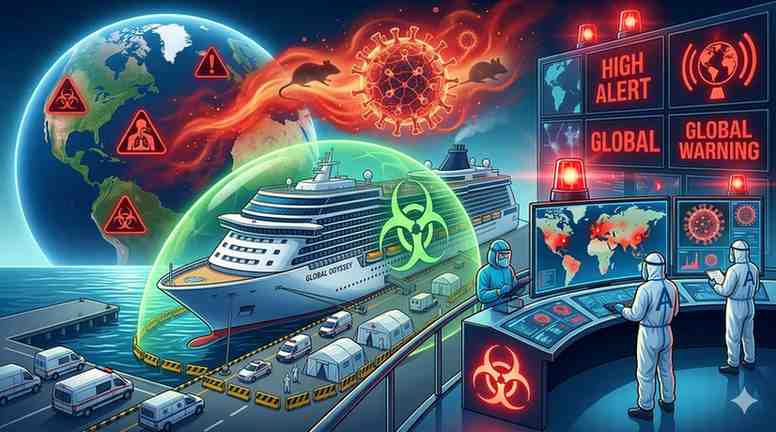
GENEVA / CAPE VERDE — The World Health Organization (WHO) has officially confirmed a cluster of Hantavirus cases linked to a Dutch expedition cruise ship, the MV Hondius. The outbreak, which has already resulted in three fatalities, has sparked international concern as passengers from the vessel have already dispersed to over 12 countries across Europe,
GENEVA / CAPE VERDE — The World Health Organization (WHO) has officially confirmed a cluster of Hantavirus cases linked to a Dutch expedition cruise ship, the MV Hondius. The outbreak, which has already resulted in three fatalities, has sparked international concern as passengers from the vessel have already dispersed to over 12 countries across Europe, North America, Asia, and Australia.
The Timeline of an Outbreak
The MV Hondius, operated by Oceanwide Expeditions, departed from the southern tip of Argentina on April 1, 2026, for an Antarctic expedition. Health investigators believe “Patient Zero” began showing symptoms as early as April 6. The first death occurred on board on April 11, though it was not initially linked to Hantavirus, leading to a critical delay in containment.
The virus is believed to have originated from rodent habitats in South America. Passengers likely became exposed during shore excursions or wildlife tourism activities, where the virus exists naturally in local rodent populations.
A Global Containment Challenge
The ship was eventually intercepted and effectively quarantined off the coast of Cape Verde after local authorities refused to let it dock, fearing a potential healthcare collapse. However, before the quarantine was established, approximately 30 passengers disembarked at Saint Helena Island and traveled to various international destinations.
Countries currently monitoring for potential cases include the UK, Germany, South Africa, Switzerland, Spain, and Singapore. The enclosed environment of the cruise ship, with shared air systems and close social contact, acted as a “perfect storm” for transmission.
Understanding the Threat: Hantavirus vs. COVID-19
Hantavirus causes Hantavirus Pulmonary Syndrome (HPS), a severe respiratory illness. While it typically spreads from rodents (mice, rats, squirrels) to humans through contact with urine or saliva, this specific outbreak involves the Andes strain, which is capable of rare human-to-human transmission through respiratory droplets.
- Lethality: Hantavirus is significantly more deadly than COVID-19, with a staggering mortality rate of 35% to 40%.
- Symptoms: It begins with flu-like symptoms—fever, fatigue, and muscle aches—but rapidly progresses to fluid-filled lungs and organ failure.
- Treatment: There is currently no specific antiviral cure; patients depend entirely on supportive care in ICUs and ventilators.
WHO Reassurance: “Not Another COVID”
Despite the high mortality rate, the WHO has stated that this is not expected to become a global pandemic on the scale of COVID-19. Officials explained that while the Andes strain can spread between humans, its transmission efficiency is very low compared to the coronavirus.
Health authorities are currently tracing transmission chains and analyzing viral samples to ensure the outbreak remains contained. For now, the public risk remains low, but the incident serves as a stark reminder of the risks associated with remote wildlife tourism and the speed of modern global travel.












Leave a Comment
Your email address will not be published. Required fields are marked with *