
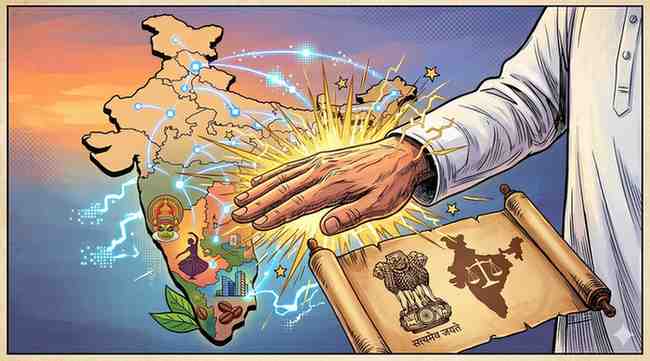
New Delhi, April 2026 — In a landmark parliamentary session, Home Minister Amit Shah issued a comprehensive rebuttal to the opposition’s narrative surrounding the Delimitation Bill. Addressing the growing concerns of Southern states, Shah utilized detailed statistical projections to argue that the proposed expansion of the Lok Sabha is a move toward democratic equilibrium, not
New Delhi, April 2026 — In a landmark parliamentary session, Home Minister Amit Shah issued a comprehensive rebuttal to the opposition’s narrative surrounding the Delimitation Bill. Addressing the growing concerns of Southern states, Shah utilized detailed statistical projections to argue that the proposed expansion of the Lok Sabha is a move toward democratic equilibrium, not a penalty for regional population control.
Breaking the “North-South” Narrative
A primary point of contention for the opposition has been the fear that Southern states would lose their political influence following a population-based census. Shah countered this by presenting a clear mathematical forecast:
- The Current Balance: Five Southern states (Karnataka, Andhra Pradesh, Telangana, Tamil Nadu, and Kerala) currently hold 129 out of 543 seats, representing 23.76% of the House.
- The Proposed Expansion: Under a 50% increase to 816 total seats, the tally for these states would rise to 195. This would result in a representation weight of 23.87%.
- The Verdict: Shah highlighted that Southern representation would actually see a marginal increase of 0.11%, asserting that “nobody is being left behind”.
A “Trust Deficit” in the House
The debate intensified when Congress leader K.C. Venugopal demanded that these seat-increase guarantees be written into the legislation itself to provide “constitutional protection”. Shah responded with a high-stakes offer, suggesting he would bring an official government amendment within the hour if the opposition committed to passing the bill immediately.
The opposition remained unmoved. Samajwadi Party leader Akhilesh Yadav stated that even a written guarantee from the BJP would not be enough to earn their trust, calling the bill a “hollow promise” designed to delay women’s reservation until after the 2029 elections.
The Representation Crisis: 4.8 Million vs. 600,000
Shah shifted the focus to the practical challenges of current parliamentary limits. He pointed to glaring inequalities in voter-to-MP ratios, citing Malkajgiri in Telangana, where a single representative serves 4.8 million voters, whereas other districts have as few as 600,000.
“One person, one vote, one value—this core principle is being violated,” Shah argued. He maintained that without delimitation, the representative nature of the Lok Sabha would continue to erode as voters’ expectations outpace their representatives’ capacity.
Censuses, Castes, and Conclusion
Addressing the demand for a Caste Census, the Home Minister confirmed that a Cabinet proposal has already been passed to ensure the upcoming census includes a caste-based count. He accused the opposition of using the issue as a “smoke screen” to distract from their own lack of initiative during past decades in power.
Shah concluded with a firm appeal for national unity, condemning any attempt to fragment the country into “North vs. South” factions. He reminded the House that every Member of Parliament takes an oath to serve the entire nation of India, not just a specific region or demographic.
Bottom Line
Amit Shah’s defense of the Delimitation Bill frames it as a mathematical and constitutional necessity rather than a political gambit. By promising a 50% seat increase across the board, the government seeks to modernize the legislature while neutralizing the opposition’s primary weapon: the fear of regional marginalization. However, with the opposition still citing a “trust deficit,” the path to implementation remains a political minefield.










Leave a Comment
Your email address will not be published. Required fields are marked with *