
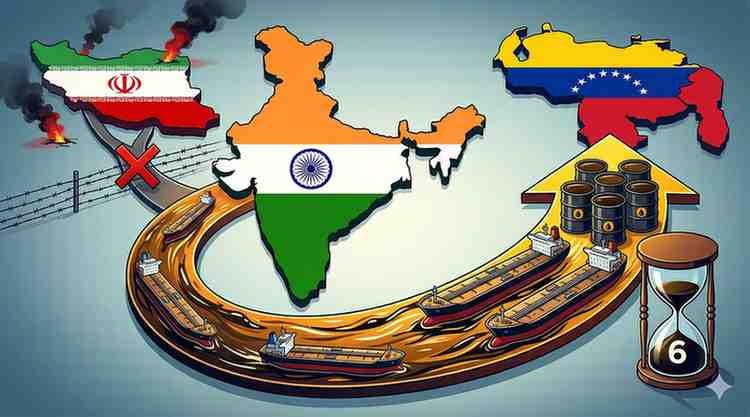
New Delhi, April 2026 — India’s energy strategy has taken a dramatic turn as the government pivots back to a long-dormant partner. To navigate the fallout of the ongoing Iran war, New Delhi is set to import its highest volume of Venezuelan crude oil in over six years. What analysts describe as a masterstroke of
New Delhi, April 2026 — India’s energy strategy has taken a dramatic turn as the government pivots back to a long-dormant partner. To navigate the fallout of the ongoing Iran war, New Delhi is set to import its highest volume of Venezuelan crude oil in over six years.
What analysts describe as a masterstroke of energy diplomacy, others see as a desperate necessity. With traditional Middle Eastern supply lines paralyzed, India is looking across the Atlantic to secure its fuel future.
The Return of the South American Giant
For years, Venezuelan oil was a ghost in the Indian market, largely due to stringent U.S. sanctions. That changed in early 2026 when Washington eased restrictions following the capture of Venezuelan President Nicolás Maduro.
The timing proved providential. Within weeks of the sanctions relief, the eruption of the Iran war effectively choked the Strait of Hormuz. This maritime chokepoint, which typically handles close to 40% of India’s oil imports, became a no-go zone, cutting off India’s primary energy arteries in one stroke.
Cracking the Chemistry: Why Venezuela?
The surge to 12 million barrels this month—the highest since February 2020—isn’t just about availability; it’s about compatibility.
- Refinery Match: Venezuela’s sulfur-rich heavy crude blends, such as the flagship Merey blend, are chemically similar to the Middle Eastern grades Indian refineries were built to process.
- The Diesel Dividend: Unlike lighter oils, Venezuelan barrels yield a higher proportion of “middle distillates”—specifically diesel and jet fuel. With global supplies of these fuels currently at a breaking point, these imports are exactly what the Indian economy needs to keep its transport and aviation sectors moving.
The Logistics of a 15,000-Mile Detour
While the move solves a supply crisis, it introduces a massive logistical headache. The shipping route from South America to India’s west coast is vastly longer than the short hop from the Persian Gulf, leading to a significant spike in freight costs.
Furthermore, the operation is fraught with complexity. Much of the oil requires risky ship-to-ship transfers off the coast of Aruba before making the long journey across the ocean. There is also the “Trump Factor”—the current U.S. administration is known for rapid policy reversals, leaving the permanence of these sanctions waivers in a state of constant uncertainty.
Diversification: Beyond the Strait of Hormuz
The crisis has exposed a dangerous reality: India imports roughly 90% of its crude oil, and its over-dependence on a single geographic region was a strategic blind spot. The return to Caracas is part of a broader “de-risking” strategy.
New Delhi isn’t just buying oil; it is building a multi-front defense. By tapping Venezuelan supplies, issuing emergency urea tenders, and maintaining strategic reserves at 64% capacity, India is attempting to manage a global energy disruption without panicking the domestic market.
Bottom Line
The era of “easy oil” from the Middle East has been temporarily halted by war. India’s pivot to Venezuela proves that in the world of energy security, there are no permanent enemies, only permanent interests. While the cost is higher and the journey longer, the message from New Delhi is clear: the lights will stay on, even if the oil has to come from the other side of the world.











Leave a Comment
Your email address will not be published. Required fields are marked with *