
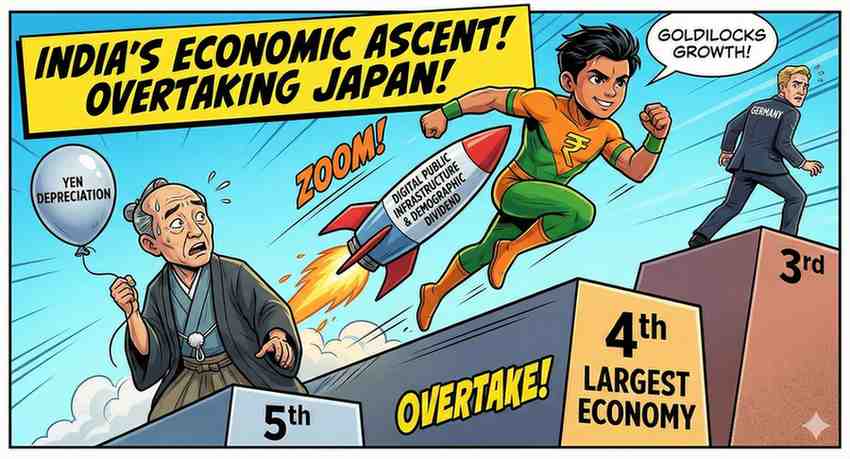
For months, financial corridors were buzzing with speculation, but the New Year has brought an official confirmation from the Indian government: India has overtaken Japan to become the world’s fourth-largest economy. What was once a series of optimistic reports is now a documented reality, signaling a seismic shift in the global financial hierarchy. The Goldilocks
For months, financial corridors were buzzing with speculation, but the New Year has brought an official confirmation from the Indian government: India has overtaken Japan to become the world’s fourth-largest economy. What was once a series of optimistic reports is now a documented reality, signaling a seismic shift in the global financial hierarchy.
The Goldilocks Moment: High Growth, Low Fever
The government has characterized this period as India’s “Goldilocks” movement. In economic terms, this describes a rare “just right” scenario: the nation is achieving high GDP growth without the typical side effect of runaway inflation. While most booming economies struggle with rising costs (CPI), India has managed to keep inflation under control, creating a stable environment for both investors and consumers.
Overtaking Japan: A Tale of Two Trajectories
The flip in rankings is a result of two diametrically opposed economic stories.
- India’s Momentum: Driven by a nominal GDP of approximately $4.187 trillion, India is currently the fastest-growing major economy, consistently hitting growth rates between 7% and 8.2%.
- Japan’s Stagnation: In contrast, Japan has faced thirty years of near-zero growth, an aging population, and “deflationary pressure”—where prices and demand remain stagnant or fall, hindering expansion.
Furthermore, currency fluctuations played a role. While the Rupee has faced challenges, the Japanese Yen’s significant depreciation against the Dollar accelerated India’s climb in the nominal GDP rankings.
The Engines of the Indian Ascent
India’s rise isn’t a stroke of luck but the result of specific structural drivers:
- The Demographic Dividend: With a median age of 28, India possesses a massive, productive workforce that supports both production and consumption.
- The “China Plus One” Strategy: As global companies look to diversify manufacturing away from China, India’s PLI (Production Linked Incentive) schemes in electronics and defense have made it a primary beneficiary.
- Digital Infrastructure: The “formalization” of the economy through UPI, GST, and Aadhaar has slashed transaction costs and brought millions of small businesses into the mainstream financial fold.
The Per Capita Reality Check
While the “4th Largest” title is a matter of national pride, the data reveals a sobering gap in individual wealth.
- Total GDP: India is 4th; Japan is 5th.
- Per Capita Income: The average Japanese citizen still earns roughly 12 times more than the average Indian. India’s per capita income sits at approximately $2,800, whereas Japan remains near $34,000.
Experts warn that for this “Great Leap” to be meaningful to the common man, the total GDP growth must translate into better healthcare, higher-quality jobs, and improved education.
Next Target: Germany 2027
The government isn’t stopping at fourth place. With Germany currently holding the third spot at roughly $4.5 trillion, India expects to overtake them within the next three years. As Germany struggles with high energy costs and a slowing global trade environment, India’s internal consumption-driven model (which accounts for 60% of its GDP) provides a sturdy buffer that makes the “Top 3” goal look increasingly inevitable by 2030.
Bottom Line India’s ascent to the fourth spot is a powerful geopolitical signal that grants the nation more leverage in the G20 and IMF. However, the true test of this milestone will not be found in the total trillion-dollar figure, but in whether the “Goldilocks” growth can eventually lift the per-person income to match the nation’s global status.












Leave a Comment
Your email address will not be published. Required fields are marked with *