





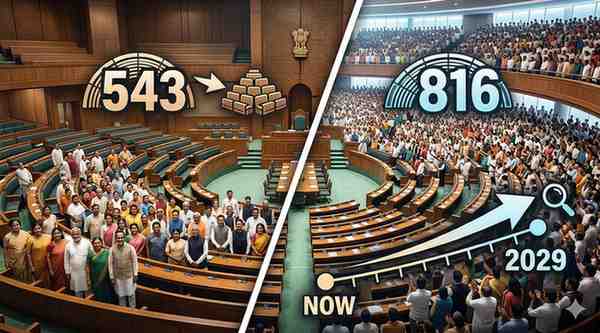
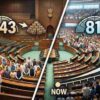
New Delhi, March 2026 — India’s democratic structure is on the verge of a historic “reset.” According to recent reports, the central government is pushing to introduce two crucial bills that will expand the Lok Sabha from its current 543 seats to a staggering 816 seats by the 2029 general elections. What supporters view as
New Delhi, March 2026 — India’s democratic structure is on the verge of a historic “reset.” According to recent reports, the central government is pushing to introduce two crucial bills that will expand the Lok Sabha from its current 543 seats to a staggering 816 seats by the 2029 general elections.
What supporters view as a necessary evolution for closer citizen representation, political analysts are calling a complex power game wrapped in structural reform.
The 2011 Census Twist For decades, the number of parliamentary seats has remained frozen. Standard constitutional procedure dictates that the next delimitation (the redrawing of electoral boundaries) should occur after the 2021 census. However, with the 2021 data delayed, the government plans a massive workaround: the new political map will be drawn based on the 2011 census. This strategic move aims to fast-track the delimitation process to strictly meet the 2029 deadline.
The Real Driver: Accommodating Women’s Reservation At the core of this monumental expansion is the implementation of the Women’s Reservation Act. Passed in 2023 after a 27-year political struggle, the law mandates a 33% reservation for women. By expanding the Lok Sabha to 816 seats, exactly 273 seats will be reserved exclusively for women. The underlying truth? Expanding the total number of seats ensures that existing male MPs do not lose their current constituencies—the primary reason this bill was stalled for nearly three decades. This move will instantly bump India’s female parliamentary representation from a mere 15% to a guaranteed 33%.
North vs. South: Defusing a Federal Crisis A purely population-based delimitation using recent data would heavily favor northern states with booming populations, effectively penalizing southern states that have successfully implemented population control measures. To avoid a massive North-South political fracture, the government’s proposed formula aims for a flat 50% seat increase across all states, anchoring the math to the older 2011 demographic baseline.
OBC Quotas and the ‘Sarpanch Pati’ Fear The road to 816 seats is paved with political hurdles. The opposition is expected to aggressively demand an OBC sub-quota within the new women’s reservation. Furthermore, political sociologists warn of the “Sarpanch Pati” syndrome making its way to Parliament—a scenario where male relatives act as proxies for newly elected female leaders, a teething problem historically witnessed in the early days of the Panchayati Raj system.
Bottom Line The leap to 816 seats is more than just filling the capacity of the new Parliament building; it is a fundamental re-engineering of Indian democracy. While it promises historic gender parity and a better MP-to-citizen ratio (dropping from 25 lakh to roughly 15-17 lakh citizens per MP), it relies on 15-year-old data. The ultimate question remains: Will a system designed on 2011 data accurately reflect the realities of a 2029 India?














Leave a Comment
Your email address will not be published. Required fields are marked with *