




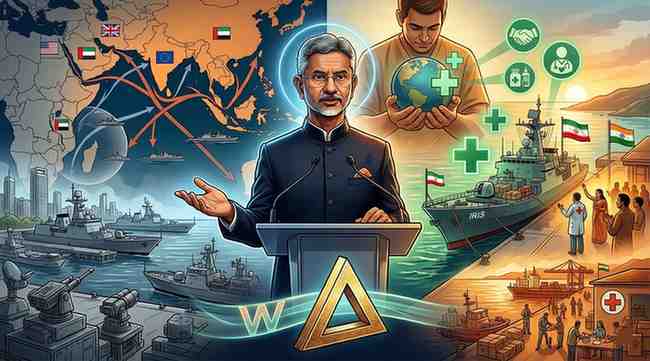
New Delhi, March 2026 — In a pointed defense of India’s maritime strategy, External Affairs Minister S. Jaishankar has dismissed social media criticism regarding the docking of the Iranian ship IRIS Dena in Kochi. Speaking at a high-level dialogue, Jaishankar emphasized that India’s decision was guided by a “humane” principle rather than political maneuvering, while
New Delhi, March 2026 — In a pointed defense of India’s maritime strategy, External Affairs Minister S. Jaishankar has dismissed social media criticism regarding the docking of the Iranian ship IRIS Dena in Kochi. Speaking at a high-level dialogue, Jaishankar emphasized that India’s decision was guided by a “humane” principle rather than political maneuvering, while reaffirming India’s central role in the Indian Ocean ecosystem.
The Kochi Docking: A “Humane” Response
The controversy began when the IRIS Dena, carrying 183 sailors including many young cadets, sought permission to enter Indian waters on February 28 due to technical difficulties. While other ships in the Iranian flotilla faced varied fates—one docking in Sri Lanka and another failing to make it—India allowed the vessel to dock in Kochi on March 1.
“When this ship wanted to come in, and that too in difficulties, I think it was the humane thing to do,” Jaishankar stated, clarifying that the cadets have since disembarked and are being housed in a nearby facility. He noted that the ships had originally set out for a fleet review before being “caught on the wrong side of events” as regional tensions flared.
The “Backyard” Reality and Diego Garcia
Addressing social media debates that suggest India’s “backyard” is being encroached upon by foreign powers, Jaishankar offered a reality check. He pointed out that Diego Garcia has hosted a foreign military presence for five decades, and foreign forces in Djibouti have been a reality since the early 2000s.
“The idea that somehow the Indian Ocean is limited to only the countries of the Indian Ocean… is a non-serious question,” he remarked, urging critics to look at the “ground on the water” situation.
Rebuilding the “Empires of the Monsoon”
Jaishankar framed India’s current diplomacy as a process of “recovery and rebuilding” an ecosystem that was broken during the colonial period. He highlighted several key pillars of this regional strategy:
- Connectivity: Restoring trade routes to the East through Myanmar and to the West via the IMAC and the International North-South Transport Corridor.
- Practical Projects: Moving beyond “sloganering” to deliver results like the Metro project in Mauritius and a unique ID card project in Sri Lanka.
- Neighborhood First: Providing the fastest substantive support to Sri Lanka during its economic crisis and responding to regional disasters like Cyclone Dwa within 24 hours.
Bottom Line
The Minister concluded by reminding the audience that the Indian Ocean is the only ocean named after a country because India sits right in its center. He asserted that India’s rise is a “lifting tide” for the entire region and that its trajectory is “unstoppable,” driven by internal strength rather than the mistakes of others.















Leave a Comment
Your email address will not be published. Required fields are marked with *