
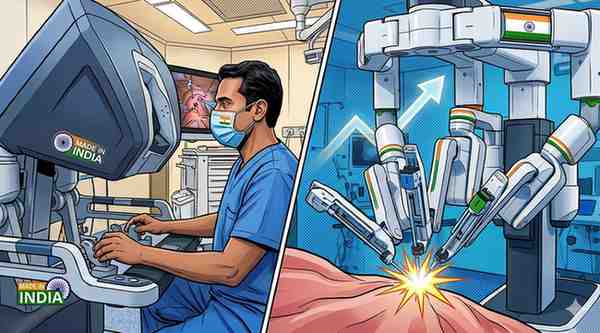
NEW DELHI — In a landmark shift for Indian healthcare, the “Make in India” movement has entered the surgical theater. The widespread adoption of the SSI Mantra, India’s first indigenous surgical robotic system, is breaking the monopoly of expensive Western technology and promising a future where high-end medical procedures are no longer a luxury reserved
NEW DELHI — In a landmark shift for Indian healthcare, the “Make in India” movement has entered the surgical theater. The widespread adoption of the SSI Mantra, India’s first indigenous surgical robotic system, is breaking the monopoly of expensive Western technology and promising a future where high-end medical procedures are no longer a luxury reserved for the elite.
The Technology: Precision Beyond the Human Hand
The SSI Mantra is a sophisticated multi-arm robotic system designed for “soft tissue” surgeries. It operates through three main pillars: a surgeon’s command center, a vision cart providing 10x 3D magnification, and the patient-side robotic arms.
Unlike traditional open surgery, the system uses “wristed” instruments that can rotate with greater flexibility than a human hand. These instruments enter the body through tiny “keyhole” ports, allowing for complex maneuvers within the chest, abdomen, or pelvis. Safety is hardwired into the interface; a head-tracking camera freezes all robotic movement the moment a surgeon looks away from the screen, ensuring absolute control.
Breaking the ₹15 Crore Barrier
For decades, robotic surgery in India was synonymous with the American-made Da Vinci system, which often carries a price tag of ₹15 to ₹18 crores. This high capital cost made the “robotic” option prohibitively expensive for the average patient.
The SSI Mantra has disrupted this economy by launching at approximately ₹6 crores—nearly one-third the price of its competitors. By significantly lowering the cost of both the machine and its maintenance, the developers have successfully decentralized advanced care. Currently, 70% of Mantra installations are located in Tier 2 and Tier 3 cities, bringing world-class precision to smaller towns that were previously ignored by tech giants.
Redefining “Work from Home”: The Rise of Telesurgery
Perhaps the most futuristic feature of this homegrown system is its capability for long-distance operations. The system’s creator recently demonstrated the ultimate version of “remote work” by performing a surgery from his living room in New Delhi on a patient located in Jaipur, 300 kilometers away.
In another record-breaking instance, a surgeon operated from France on a patient in Indore—a staggering 10,000 kilometers apart. As long as high-speed connectivity is available, the physical location of the specialist no longer limits the patient’s access to life-saving expertise.
From Skepticism to Demand
While the idea of a “robot” performing surgery once sparked fear, the narrative in Indian hospitals has flipped. Surgeons report that patients now arrive at hospitals specifically requesting robotic procedures. The promise of less pain, minimal blood loss, and a faster return to work has replaced the old-school preference for “open” surgeries.
Bottom Line
The SSI Mantra is more than just a machine; it is a statement of India’s growing medical sovereignty. By proving that advanced robotics can be both “Made in India” and affordable, the system is ensuring that the future of healthcare isn’t just about innovation—it’s about access. No longer a “video game” for doctors, this technology is a vital tool in ensuring no patient is left behind due to their geography or their bank balance.










Leave a Comment
Your email address will not be published. Required fields are marked with *