
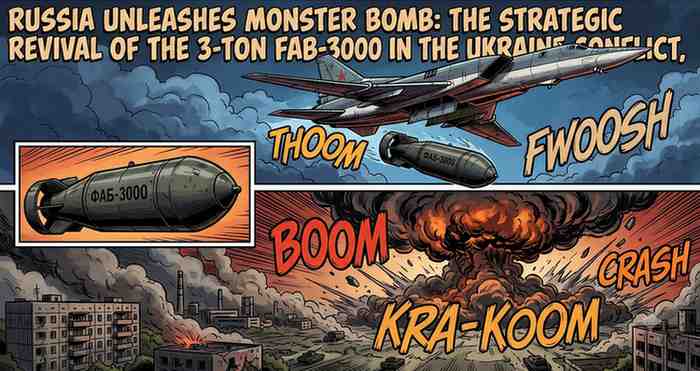
Moscow, July 2026 — Russia has unleashed a relic from its past to escalate the conflict in Ukraine, turning a massive Soviet-era weapon into a modern nightmare. The deployment of the FAB-3000—a monster three-ton conventional bomb—marks a terrifying shift in strategy. What supporters call a highly efficient tactical upgrade, critics view as the brutal deployment
Moscow, July 2026 — Russia has unleashed a relic from its past to escalate the conflict in Ukraine, turning a massive Soviet-era weapon into a modern nightmare.
The deployment of the FAB-3000—a monster three-ton conventional bomb—marks a terrifying shift in strategy. What supporters call a highly efficient tactical upgrade, critics view as the brutal deployment of an indiscriminate weapon modified to bypass modern defenses.
Turning a Dumb Bomb into a Smart Killer
Originally manufactured during the Cold War to fight NATO, the FAB-3000 was built as a “gravity bomb.” For decades, it sat idle because dropping it required aircraft to fly directly over a target, making the planes easy prey for modern air defense systems.
Russia solved this bottleneck through cheap technology. By attaching a UMPK (Unified Gliding and Correction Module) kit, engineers added fold-out wings and satellite navigation connected to their GLONASS system.
The result? An ancient, unguided block of explosives is transformed into a precision glide bomb. Russian Sukhoi-34 bombers no longer need to enter dangerous Ukrainian airspace; they simply release the weapon from dozens of kilometers away and let it glide to its destination.
The Brutal Economics of Destruction
The strategic shift comes down to calculated wartime economics. Building advanced cruise missiles requires complex electronics, expensive engines, and rare components.
In contrast, Russia has massive stockpiles of old FAB bombs. Retrofitting them with a basic guidance kit costs a fraction of a missile’s price while delivering vastly superior destructive power. Packed with nearly 1,400 kilograms of high explosives, a single strike creates a massive blast wave that pulverizes concrete bunkers, collapses fortified command centers, and tears apart military infrastructure.
Drones Spot, Bombers Strike
The operational loop is simple but devastating. Russian reconnaissance drones first penetrate Ukrainian territory to film and log precise coordinates. Once a target is locked, a bomber approaches the border, releases the gliding monster, and turns back long before Ukrainian surface-to-air missiles can lock onto the aircraft. The kinetic energy of the heavy steel-cased bomb leaves massive craters, completely neutralizing defensive lines and runways.
Global Imitation and Crucial Limitations
This strategy of turning old iron into smart weapons is not unique to Russia. The United States has long used JDAM kits for the same purpose, and India recently achieved a similar breakthrough with its TARA glide kit, designed by the DRDO to modernize its own unguided stockpiles.
However, the FAB-3000 has significant flaws. It cannot track fast-moving targets and lacks the flight flexibility of a cruise missile. More critically, its massive blast radius creates a devastating human cost, posing an extreme risk to civilians and raising severe international human rights concerns.
Bottom Line
The revival of the FAB-3000 is about maximizing destruction while saving money. By slapping wings onto Soviet relics, Russia is exploiting a loophole in modern air defenses—turning historical dead weight into a cheap, devastatingly effective tool of modern warfare.












Leave a Comment
Your email address will not be published. Required fields are marked with *