
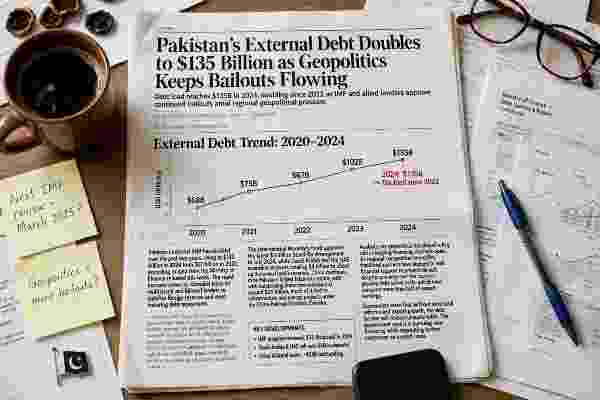
Islamabad, November 2026 — World Bank data has laid bare the scale of Pakistan’s economic crisis: its external debt has nearly doubled in a decade, climbing to $135 billion. Yet despite chronic instability and repeated brushes with default, global lenders keep writing fresh cheques. A Decade of Doubling Debt In 2015, Pakistan owed roughly $68
Islamabad, November 2026 — World Bank data has laid bare the scale of Pakistan’s economic crisis: its external debt has nearly doubled in a decade, climbing to $135 billion. Yet despite chronic instability and repeated brushes with default, global lenders keep writing fresh cheques.
A Decade of Doubling Debt In 2015, Pakistan owed roughly $68 billion to foreign creditors; by 2025, that figure hit $135 billion. A staggering $107 billion of this is public and publicly guaranteed debt tied to state assets, alongside $57 billion owed to multilateral institutions and $42 billion to bilateral lenders.
The daily toll is severe. In 2025, debt servicing swallowed 33% of Pakistan’s export earnings, leaving minimal room for development or essential imports. External debt now equals 34% of Gross National Income—nearly double India’s 18%.
Borrowing Just to Pay Old Bills Political volatility—with no Pakistani prime minister ever completing a full five-year term—has prevented lasting economic reform. Instead, Islamabad is locked in a loop of taking new loans to service old ones.
In 2025–26 alone, Pakistan borrowed $16.16 billion externally but repaid just $14.44 billion, including $11 billion in principal and $3.24 billion in interest. Rather than shrinking, its debt pile grew by another $1.72 billion.
Who Keeps Funding Pakistan—and Why?China: Islamabad’s largest bilateral creditor at $22.4 billion, heavily tied to the China-Pakistan Economic Corridor. Beijing routinely rolls over maturing loans to secure Arabian Sea access and maintain strategic pressure on India.
The IMF and the U.S.: Since 1950, Pakistan has secured 24 to 25 IMF bailouts, including $1.21 billion cleared in October 2026. The United States, which holds an effective 16.5% veto at the Fund, keeps backing rescues to preserve nuclear stability, maintain counter-terrorism leverage, and prevent Islamabad from falling fully into China’s orbit.
World Bank and Gulf Allies: The World Bank has lent $19.2 billion for targeted healthcare, education, and infrastructure projects to stave off deeper poverty. Saudi Arabia props up forex reserves through deposits and deferred oil payments, though UAE backing has cooled as Abu Dhabi moves closer to India.
Too Strategic to Fail? Whenever sovereign default looms, geography comes to the rescue—China, Saudi Arabia, or the IMF inevitably steps in at the brink. But bailouts only buy time. Without political stability and structural reform, Pakistan remains trapped in a cycle where fresh loans merely postpone the inevitable.








Leave a Comment
Your email address will not be published. Required fields are marked with *