
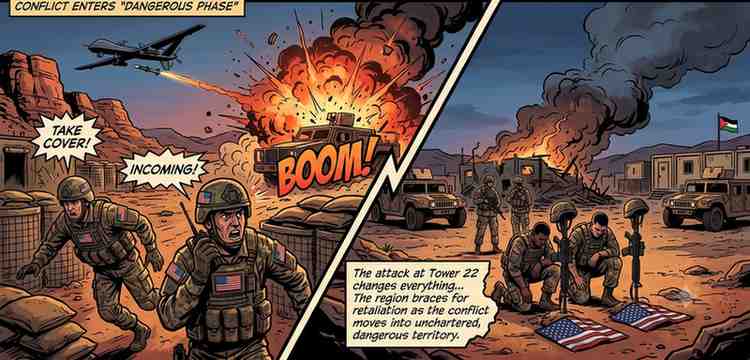
Amman, July 2026 — The ongoing conflict between the United States and Iran has escalated into a highly perilous phase, shattered by a deadly direct assault on American forces stationed in Jordan. While proponents of the geopolitical standoff claim these moves are necessary defensive posturing, critics warn that the region has crossed a threshold into
Amman, July 2026 — The ongoing conflict between the United States and Iran has escalated into a highly perilous phase, shattered by a deadly direct assault on American forces stationed in Jordan. While proponents of the geopolitical standoff claim these moves are necessary defensive posturing, critics warn that the region has crossed a threshold into an open war where critical infrastructure and human lives are rapidly becoming expendable.
The Illusion of Safety in Jordan
For years, Jordan has served as a vital, quiet hub for American operations in the Middle East, hosting thousands of troops for counter-terrorism, regional logistics, and sophisticated intelligence operations. Bases like the Muwaffaq Salti Air Base in the Zarqa province acted as a shield and refuelling center for U.S. fighter jets and drones.
That illusion of a safe sanctuary vanished overnight. A coordinated barrage of ballistic missiles and armed drones, launched by Iran-backed forces, completely overwhelmed local air defense systems. Two U.S. service members were killed, one remains missing, and dozens were injured in what has become the deadliest direct attack on American forces in the current conflict.
A Calculated Shift to Total Infrastructure War
What makes this current phase uniquely dangerous is the tactical pivot from strictly targeting military personnel to crippling vital civilian and economic infrastructure.
In swift retaliation for the drone strikes, President Donald Trump authorized intense American airstrikes targeting missile launch facilities and drone storage units in southern Iran, intentionally destroying bridges that connect to major maritime hubs like the Port of Bandar Abbas.
Tehran did not back down. In a series of immediate counter-strikes, Iranian missiles targeted power grids and water desalination plants in Kuwait, Bahrain, and Qatar—nations that host U.S. military assets. This shift threatens to paralyze everyday life, as attacking these assets compromises hospitals, banking networks, and the freshwater supplies that millions of citizens rely on.
Panic and Surging Costs in the Gulf
The expanding conflict has sent shockwaves through the Gulf Cooperation Council (GCC), causing immense anxiety in nations like Saudi Arabia and the UAE. These states thrive on stability, foreign investment, and open shipping channels.
The immediate fallout of the infrastructure war includes:
- Skyrocketing Oil Prices: Crude prices, which had previously stabilized below $70, have surged rapidly back toward the $85–$90 per barrel range.
- Choked Maritime Routes: The threat of a full blockade or heavy fighting around the vital Strait of Hormuz has sent maritime insurance costs through the roof, disrupting global supply chains.
The Mask of Diplomacy Comes Off
Behind the scenes, any remaining diplomatic guardrails have completely dissolved. Tehran has officially suspended its 60-day Memorandum of Understanding (MoU) with the United States, declaring that Washington’s repeated violations have made the agreement entirely void.
Domestically, aggressive war propaganda is surging within Iran. Public billboards now depict a burning White House alongside images of coffins bearing the names of Trump and his family, with public demands for “blood for blood” echoing through the streets.
Bottom Line
The era of localized proxy skirmishes between the U.S. and Iran is over. With the deliberate targeting of regional infrastructure and the official termination of diplomatic channels, both nations have stripped away the pretenses of restraint. As the war expands, the primary casualties are no longer just military assets, but the economic and societal lifelines of the entire Middle East.











Leave a Comment
Your email address will not be published. Required fields are marked with *