





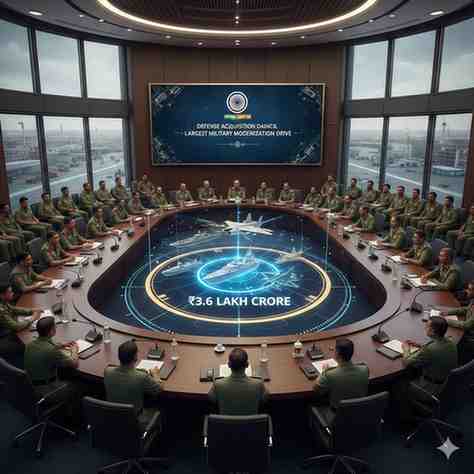
New Delhi, February 2026 —The move, chaired by Defense Minister Rajnath Singh, isn’t just a shopping list—it is a strategic pivot. By prioritizing “Acceptance of Necessity” (AoN) for indigenous production, India is attempting to break its decades-long shackles of foreign dependency and transform into a global defense exporter. The Rafale Expansion: Filling the Skies The
New Delhi, February 2026 —The move, chaired by Defense Minister Rajnath Singh, isn’t just a shopping list—it is a strategic pivot. By prioritizing “Acceptance of Necessity” (AoN) for indigenous production, India is attempting to break its decades-long shackles of foreign dependency and transform into a global defense exporter.
The Rafale Expansion: Filling the Skies
The headline of this overhaul is the approval for 114 Multi-Role Fighter Aircraft (MRFA). While India currently operates a limited fleet of French Rafales, this new deal for 4.5-generation jets is designed to bridge the “squadron gap” that has long worried the Indian Air Force (IAF).
The “Make in India” twist is clear: only 18 jets will arrive in “fly-away” condition from France. The remaining 96 will be built on Indian soil. If the Cabinet Committee on Security (CCS) gives the final nod, India’s Rafale strength will jump to 176, creating a massive long-range deterrent against two-front threats from Pakistan and China.
Intelligence Beyond Orbit: The Pseudo-Satellite
In a leap for border surveillance, the IAF is set to deploy Airship-based High Altitude Pseudo-Satellites (HAPS). These aren’t traditional satellites, but they act like them—hovering at extreme altitudes to provide 24/7 monitoring of the LAC and LOC.
Unlike orbital satellites that pass over a target periodically, these airships stay stationary. They are designed to intercept enemy radar, monitor troop movements, and provide high-resolution remote sensing, essentially giving Indian commanders a “god’s-eye view” of the battlefield without the billion-dollar price tag of space launches.
High-Seas Dominance and Submarine Hunting
The Indian Navy’s segment of the budget focuses heavily on the Indian Ocean Region (IOR). The procurement of U.S.-made P8I Poseidon aircraft is a direct response to increasing Chinese submarine patrols. These aircraft are specialized for “submarine hunting” and long-range maritime strikes.
Furthermore, the Navy is pushing for indigenous 4-megawatt marine gas turbine generators. These engines are the heart of submarine power systems. By developing these internally, India ensures that its silent killers under the sea are powered by Indian tech, not foreign spare parts.
Army Upgrades: Rebirth of the T-72
The Indian Army is taking a “recover and reinvent” approach. Rather than buying entirely new tank divisions, the focus is on a massive upgrade of the T-72 tanks and BMP-2 infantry combat vehicles.
By integrating modern thermal sights, better armor, and the newly approved Vibhav anti-tank mines, the Army is turning its Cold War-era workhorses into 21st-century digital combatants.
The Coast Guard’s Digital Eyes
Even the coastline is getting a digital shield. The Dornier aircraft used by the Coast Guard will be fitted with advanced Electro-Optical/Infrared (EO/IR) systems. These high-powered thermal cameras can spot a smuggling boat or an infiltration attempt in pitch darkness, specifically targeting illegal fishing and maritime “grey-zone” warfare.
Bottom Line
The ₹3.6 lakh crore clearance isn’t just about buying hardware; it’s about building an Atmanirbhar (Self-Reliant) defense ecosystem. By shifting from “importing” to “manufacturing,” India is betting that its next great war won’t be won with foreign signatures, but with home-grown steel and software.




















Leave a Comment
Your email address will not be published. Required fields are marked with *